| Record Information |
|---|
| Version | 2.0 |
|---|
| Creation Date | 2010-05-27 14:58:19 UTC |
|---|
| Update Date | 2014-12-24 20:26:32 UTC |
|---|
| Accession Number | T3D3775 |
|---|
| Identification |
|---|
| Common Name | Slaframine |
|---|
| Class | Small Molecule |
|---|
| Description | Slaframine is a mycotoxin produced by the fungus Rizoctonia leguminicola. It is a parasympathomimetic compound and causes increased exocrine function, especially salivation. Along with swainsonine, the other biologially active compound of R. leguminicola, it is known to cause a condition called "slobbers syndrome" in livestock that has ingested contaminated feed. (1, 2) |
|---|
| Compound Type | - Amine
- Ester
- Ether
- Fungal Toxin
- Mycotoxin
- Natural Compound
- Organic Compound
|
|---|
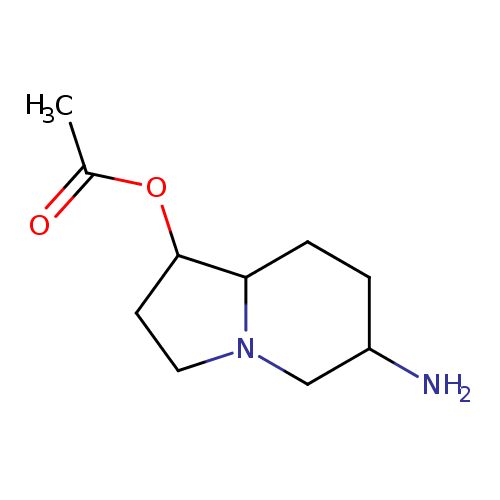
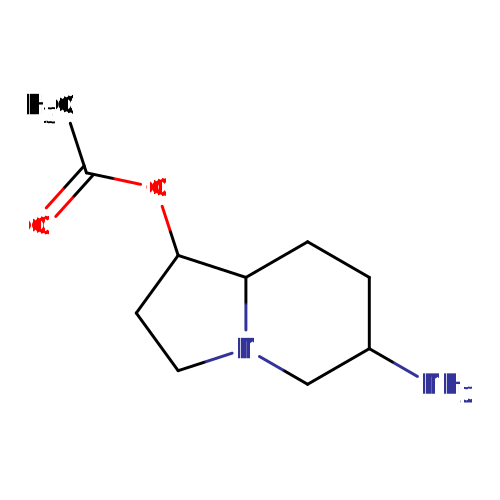
| Chemical Structure | |
|---|
| Synonyms | | Synonym | | (1S,6S,8aS)-1-Acetoxy-6-aminooctahydroindolizine | | (1S-(1alpha,6alpha,8abeta))-6-Aminooctahydro-1-indolizinol, acetate (ester) |
|
|---|
| Chemical Formula | C10H18N2O2 |
|---|
| Average Molecular Mass | 198.262 g/mol |
|---|
| Monoisotopic Mass | 198.137 g/mol |
|---|
| CAS Registry Number | 20084-93-9 |
|---|
| IUPAC Name | 6-amino-octahydroindolizin-1-yl acetate |
|---|
| Traditional Name | slaframine |
|---|
| SMILES | CC(=O)OC1CCN2CC(N)CCC12 |
|---|
| InChI Identifier | InChI=1S/C10H18N2O2/c1-7(13)14-10-4-5-12-6-8(11)2-3-9(10)12/h8-10H,2-6,11H2,1H3 |
|---|
| InChI Key | InChIKey=YYIUHLPAZILPSG-UHFFFAOYSA-N |
|---|
| Chemical Taxonomy |
|---|
| Description | belongs to the class of organic compounds known as indolizidines. These are polycyclic compounds containing an indolizidine, which is a bicyclic heterocycle containing a saturated six-member ring fused to a saturated five-member ring, one of the bridging atoms being nitrogen. |
|---|
| Kingdom | Organic compounds |
|---|
| Super Class | Organoheterocyclic compounds |
|---|
| Class | Indolizidines |
|---|
| Sub Class | Not Available |
|---|
| Direct Parent | Indolizidines |
|---|
| Alternative Parents | |
|---|
| Substituents | - Indolizidine
- 3-aminopiperidine
- Piperidine
- N-alkylpyrrolidine
- Pyrrolidine
- Amino acid or derivatives
- Carboxylic acid ester
- Tertiary amine
- Tertiary aliphatic amine
- Monocarboxylic acid or derivatives
- Carboxylic acid derivative
- Azacycle
- Organic oxide
- Primary amine
- Organopnictogen compound
- Organooxygen compound
- Organonitrogen compound
- Primary aliphatic amine
- Organic oxygen compound
- Amine
- Carbonyl group
- Organic nitrogen compound
- Hydrocarbon derivative
- Aliphatic heteropolycyclic compound
|
|---|
| Molecular Framework | Aliphatic heteropolycyclic compounds |
|---|
| External Descriptors | Not Available |
|---|
| Biological Properties |
|---|
| Status | Detected and Not Quantified |
|---|
| Origin | Exogenous |
|---|
| Cellular Locations | |
|---|
| Biofluid Locations | Not Available |
|---|
| Tissue Locations | Not Available |
|---|
| Pathways | Not Available |
|---|
| Applications | Not Available |
|---|
| Biological Roles | |
|---|
| Chemical Roles | Not Available |
|---|
| Physical Properties |
|---|
| State | Solid |
|---|
| Appearance | White powder. |
|---|
| Experimental Properties | | Property | Value |
|---|
| Melting Point | Not Available | | Boiling Point | Not Available | | Solubility | Not Available | | LogP | Not Available |
|
|---|
| Predicted Properties | |
|---|
| Spectra |
|---|
| Spectra | | Spectrum Type | Description | Splash Key | Deposition Date | View |
|---|
| Predicted GC-MS | Predicted GC-MS Spectrum - GC-MS (Non-derivatized) - 70eV, Positive | splash10-03dl-7900000000-82f2ebd8b74ca296ae06 | 2021-09-23 | View Spectrum | | Predicted GC-MS | Predicted GC-MS Spectrum - GC-MS (Non-derivatized) - 70eV, Positive | Not Available | 2021-10-12 | View Spectrum | | Predicted GC-MS | Predicted GC-MS Spectrum - GC-MS (Non-derivatized) - 70eV, Positive | Not Available | 2021-10-12 | View Spectrum | | Predicted LC-MS/MS | Predicted LC-MS/MS Spectrum - 10V, Positive | splash10-0532-0900000000-e31134aa571d68f62949 | 2016-08-03 | View Spectrum | | Predicted LC-MS/MS | Predicted LC-MS/MS Spectrum - 20V, Positive | splash10-00ei-0900000000-0aa0e3ad7c69dbd764af | 2016-08-03 | View Spectrum | | Predicted LC-MS/MS | Predicted LC-MS/MS Spectrum - 40V, Positive | splash10-0006-9300000000-14ded616dbe500acc3d0 | 2016-08-03 | View Spectrum | | Predicted LC-MS/MS | Predicted LC-MS/MS Spectrum - 10V, Negative | splash10-0002-0900000000-17ca17bff4342baf2ea4 | 2016-08-03 | View Spectrum | | Predicted LC-MS/MS | Predicted LC-MS/MS Spectrum - 20V, Negative | splash10-0a4j-1900000000-9bb2c6c50e2aaf1c5ddd | 2016-08-03 | View Spectrum | | Predicted LC-MS/MS | Predicted LC-MS/MS Spectrum - 40V, Negative | splash10-052f-9600000000-46d6f441fe573e243688 | 2016-08-03 | View Spectrum | | Predicted LC-MS/MS | Predicted LC-MS/MS Spectrum - 10V, Positive | splash10-0002-0900000000-5141251c4241c3b70bb3 | 2021-10-12 | View Spectrum | | Predicted LC-MS/MS | Predicted LC-MS/MS Spectrum - 20V, Positive | splash10-000b-0900000000-f677d3548283e11f7354 | 2021-10-12 | View Spectrum | | Predicted LC-MS/MS | Predicted LC-MS/MS Spectrum - 40V, Positive | splash10-008d-9400000000-35f0355727c4637e8ea2 | 2021-10-12 | View Spectrum | | Predicted LC-MS/MS | Predicted LC-MS/MS Spectrum - 10V, Negative | splash10-0a4j-6900000000-6538746085fac967dfb3 | 2021-10-12 | View Spectrum | | Predicted LC-MS/MS | Predicted LC-MS/MS Spectrum - 20V, Negative | splash10-0a4i-6900000000-9ddfe2dcf6691f0632eb | 2021-10-12 | View Spectrum | | Predicted LC-MS/MS | Predicted LC-MS/MS Spectrum - 40V, Negative | splash10-0a4l-9200000000-1e576b18d69f4123a41b | 2021-10-12 | View Spectrum | | 1D NMR | 13C NMR Spectrum (1D, 100 MHz, D2O, predicted) | Not Available | 2021-10-12 | View Spectrum | | 1D NMR | 1H NMR Spectrum (1D, 100 MHz, D2O, predicted) | Not Available | 2021-10-12 | View Spectrum | | 1D NMR | 13C NMR Spectrum (1D, 1000 MHz, D2O, predicted) | Not Available | 2021-10-12 | View Spectrum | | 1D NMR | 1H NMR Spectrum (1D, 1000 MHz, D2O, predicted) | Not Available | 2021-10-12 | View Spectrum | | 1D NMR | 13C NMR Spectrum (1D, 200 MHz, D2O, predicted) | Not Available | 2021-10-12 | View Spectrum | | 1D NMR | 1H NMR Spectrum (1D, 200 MHz, D2O, predicted) | Not Available | 2021-10-12 | View Spectrum | | 1D NMR | 13C NMR Spectrum (1D, 300 MHz, D2O, predicted) | Not Available | 2021-10-12 | View Spectrum | | 1D NMR | 1H NMR Spectrum (1D, 300 MHz, D2O, predicted) | Not Available | 2021-10-12 | View Spectrum | | 1D NMR | 13C NMR Spectrum (1D, 400 MHz, D2O, predicted) | Not Available | 2021-10-12 | View Spectrum | | 1D NMR | 1H NMR Spectrum (1D, 400 MHz, D2O, predicted) | Not Available | 2021-10-12 | View Spectrum | | 1D NMR | 13C NMR Spectrum (1D, 500 MHz, D2O, predicted) | Not Available | 2021-10-12 | View Spectrum | | 1D NMR | 1H NMR Spectrum (1D, 500 MHz, D2O, predicted) | Not Available | 2021-10-12 | View Spectrum | | 1D NMR | 13C NMR Spectrum (1D, 600 MHz, D2O, predicted) | Not Available | 2021-10-12 | View Spectrum | | 1D NMR | 1H NMR Spectrum (1D, 600 MHz, D2O, predicted) | Not Available | 2021-10-12 | View Spectrum | | 1D NMR | 13C NMR Spectrum (1D, 700 MHz, D2O, predicted) | Not Available | 2021-10-12 | View Spectrum | | 1D NMR | 1H NMR Spectrum (1D, 700 MHz, D2O, predicted) | Not Available | 2021-10-12 | View Spectrum | | 1D NMR | 13C NMR Spectrum (1D, 800 MHz, D2O, predicted) | Not Available | 2021-10-12 | View Spectrum | | 1D NMR | 1H NMR Spectrum (1D, 800 MHz, D2O, predicted) | Not Available | 2021-10-12 | View Spectrum | | 1D NMR | 13C NMR Spectrum (1D, 900 MHz, D2O, predicted) | Not Available | 2021-10-12 | View Spectrum | | 1D NMR | 1H NMR Spectrum (1D, 900 MHz, D2O, predicted) | Not Available | 2021-10-12 | View Spectrum |
|
|---|
| Toxicity Profile |
|---|
| Route of Exposure | Oral, dermal, inhalation, and parenteral (contaminated drugs). (4) |
|---|
| Mechanism of Toxicity | Slaframine is a parasympathomimetic compound and causes increased secretion by salivary glands, pancreas, and other exocrine and endocrine glands. This is due to its activity as a cholingergic agonist. Slaframine has a high affinity for muscarinic receptors, especially in the gastrointestinal tract, and it stimulates these to produce its parasympathomimetic effects. Slaframine is also known to affect the concentration of circulating metabolic hormones, though the mechanism of this is unknown. (1, 2) |
|---|
| Metabolism | Slaframine is though to be activated in the liver by a hepatic microsomal flavoprotein oxidase to a ketoimine metabolite with a configuration similar to that of the parasympathetic neurotransmitter acetylcholine. (2) |
|---|
| Toxicity Values | Not Available |
|---|
| Lethal Dose | LD50: 11 mg/kg (Broiler chick) (3) |
|---|
| Carcinogenicity (IARC Classification) | No indication of carcinogenicity to humans (not listed by IARC). |
|---|
| Uses/Sources | Slaframine is a mycotoxin produced by the fungus Rizoctonia leguminicola. (1) |
|---|
| Minimum Risk Level | Not Available |
|---|
| Health Effects | Slaframine is a parasympathomimetic compound and causes increased exocrine function, especially salivation. Along with swainsonine, the other biologially active compound of R. leguminicola, it is known to cause a condition called "slobbers syndrome" in livestock that has ingested contaminated feed. (1, 2) |
|---|
| Symptoms | The major symptom of "slobbers syndrome" is profuse salivation. Other symptoms include diarrhea, lacrimation, stiff joints, frequent urination, tremors, spontaneous abortion, labored breathing, loss of appetite, bloat, and possibly death. (2) |
|---|
| Treatment | The effects of slaframine can be prevented by pre-treatment with an muscarinic receptor antagonist such as atropine or pirenzepine. (2) |
|---|
| Normal Concentrations |
|---|
| Not Available |
|---|
| Abnormal Concentrations |
|---|
| Not Available |
|---|
| External Links |
|---|
| DrugBank ID | Not Available |
|---|
| HMDB ID | Not Available |
|---|
| PubChem Compound ID | 88363 |
|---|
| ChEMBL ID | Not Available |
|---|
| ChemSpider ID | Not Available |
|---|
| KEGG ID | Not Available |
|---|
| UniProt ID | Not Available |
|---|
| OMIM ID | |
|---|
| ChEBI ID | Not Available |
|---|
| BioCyc ID | Not Available |
|---|
| CTD ID | Not Available |
|---|
| Stitch ID | Not Available |
|---|
| PDB ID | Not Available |
|---|
| ACToR ID | Not Available |
|---|
| Wikipedia Link | Not Available |
|---|
| References |
|---|
| Synthesis Reference | Not Available |
|---|
| MSDS | Not Available |
|---|
| General References | - Chapa AM, Fernandez JM, Thompson DL Jr, Tempelman RJ, Berrio LF, Croom WJ Jr, Hagler WM Jr: Endocrine and metabolic response to muscarinic stimulation and inhibition in the ruminant: effects of slaframine. J Anim Sci. 1995 Dec;73(12):3673-80. [8655443 ]
- Croom WJ Jr, Hagler WM Jr, Froetschel MA, Johnson AD: The involvement of slaframine and swainsonine in slobbers syndrome: a review. J Anim Sci. 1995 May;73(5):1499-508. [7665382 ]
- Broquist HP: The indolizidine alkaloids, slaframine and swainsonine: contaminants in animal forages. Annu Rev Nutr. 1985;5:391-409. [3927948 ]
- Peraica M, Domijan AM: Contamination of food with mycotoxins and human health. Arh Hig Rada Toksikol. 2001 Mar;52(1):23-35. [11370295 ]
|
|---|
| Gene Regulation |
|---|
| Up-Regulated Genes | Not Available |
|---|
| Down-Regulated Genes | Not Available |
|---|