
Amanullinic acid (T3D3589)
| Record Information | |||||||||||||||||||||||||||||||||||||||||||||||||||||||||||||
|---|---|---|---|---|---|---|---|---|---|---|---|---|---|---|---|---|---|---|---|---|---|---|---|---|---|---|---|---|---|---|---|---|---|---|---|---|---|---|---|---|---|---|---|---|---|---|---|---|---|---|---|---|---|---|---|---|---|---|---|---|---|
| Version | 2.0 | ||||||||||||||||||||||||||||||||||||||||||||||||||||||||||||
| Creation Date | 2009-08-12 21:34:06 UTC | ||||||||||||||||||||||||||||||||||||||||||||||||||||||||||||
| Update Date | 2014-12-24 20:26:11 UTC | ||||||||||||||||||||||||||||||||||||||||||||||||||||||||||||
| Accession Number | T3D3589 | ||||||||||||||||||||||||||||||||||||||||||||||||||||||||||||
| Identification | |||||||||||||||||||||||||||||||||||||||||||||||||||||||||||||
| Common Name | Amanullinic acid | ||||||||||||||||||||||||||||||||||||||||||||||||||||||||||||
| Class | Small Molecule | ||||||||||||||||||||||||||||||||||||||||||||||||||||||||||||
| Description | Amanullinic acid is one of a group of at least eight Amatoxins found in several genera of poisonous mushrooms, most notably Amanita phalloides and several other members of the genus Amanita, as well as some Conocybe, Galerina and Lepiota mushroom species. (3) | ||||||||||||||||||||||||||||||||||||||||||||||||||||||||||||
| Compound Type |
| ||||||||||||||||||||||||||||||||||||||||||||||||||||||||||||
| Chemical Structure | 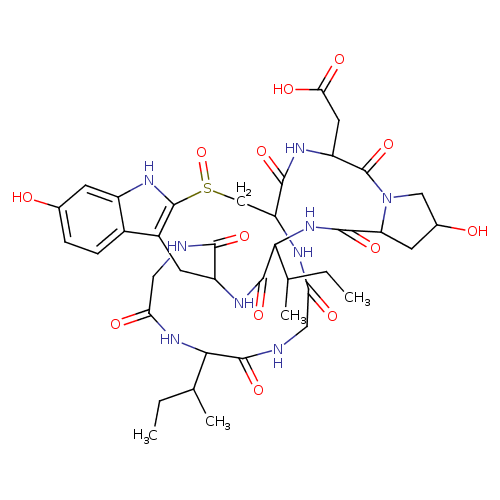 | ||||||||||||||||||||||||||||||||||||||||||||||||||||||||||||
| Synonyms |
| ||||||||||||||||||||||||||||||||||||||||||||||||||||||||||||
| Chemical Formula | C39H53N9O13S | ||||||||||||||||||||||||||||||||||||||||||||||||||||||||||||
| Average Molecular Mass | 887.956 g/mol | ||||||||||||||||||||||||||||||||||||||||||||||||||||||||||||
| Monoisotopic Mass | 887.348 g/mol | ||||||||||||||||||||||||||||||||||||||||||||||||||||||||||||
| CAS Registry Number | 54532-45-5 | ||||||||||||||||||||||||||||||||||||||||||||||||||||||||||||
| IUPAC Name | 2-[13,34-bis(butan-2-yl)-8,22-dihydroxy-2,5,11,14,27,30,33,36,39-nonaoxo-27λ⁴-thia-3,6,12,15,25,29,32,35,38-nonaazapentacyclo[14.12.11.0⁶,¹⁰.0¹⁸,²⁶.0¹⁹,²⁴]nonatriaconta-18(26),19,21,23-tetraen-4-yl]acetic acid | ||||||||||||||||||||||||||||||||||||||||||||||||||||||||||||
| Traditional Name | amanullinic acid | ||||||||||||||||||||||||||||||||||||||||||||||||||||||||||||
| SMILES | CCC(C)C1NC(=O)CNC(=O)C2CC3=C(NC4=CC(O)=CC=C34)S(=O)CC(NC(=O)CNC1=O)C(=O)NC(CC(O)=O)C(=O)N1CC(O)CC1C(=O)NC(C(C)CC)C(=O)N2 | ||||||||||||||||||||||||||||||||||||||||||||||||||||||||||||
| InChI Identifier | InChI=1S/C39H53N9O13S/c1-5-17(3)31-36(58)41-13-28(51)42-26-16-62(61)38-22(21-8-7-19(49)9-23(21)45-38)11-24(33(55)40-14-29(52)46-31)43-37(59)32(18(4)6-2)47-35(57)27-10-20(50)15-48(27)39(60)25(12-30(53)54)44-34(26)56/h7-9,17-18,20,24-27,31-32,45,49-50H,5-6,10-16H2,1-4H3,(H,40,55)(H,41,58)(H,42,51)(H,43,59)(H,44,56)(H,46,52)(H,47,57)(H,53,54) | ||||||||||||||||||||||||||||||||||||||||||||||||||||||||||||
| InChI Key | InChIKey=HFENEIQMWRYNGK-UHFFFAOYSA-N | ||||||||||||||||||||||||||||||||||||||||||||||||||||||||||||
| Chemical Taxonomy | |||||||||||||||||||||||||||||||||||||||||||||||||||||||||||||
| Description | belongs to the class of organic compounds known as amatoxins. These are cyclic peptides containing eight amino acid residues arranged in a macrobicyclic motif. | ||||||||||||||||||||||||||||||||||||||||||||||||||||||||||||
| Kingdom | Organic compounds | ||||||||||||||||||||||||||||||||||||||||||||||||||||||||||||
| Super Class | Organic acids and derivatives | ||||||||||||||||||||||||||||||||||||||||||||||||||||||||||||
| Class | Carboxylic acids and derivatives | ||||||||||||||||||||||||||||||||||||||||||||||||||||||||||||
| Sub Class | Amino acids, peptides, and analogues | ||||||||||||||||||||||||||||||||||||||||||||||||||||||||||||
| Direct Parent | Amatoxins | ||||||||||||||||||||||||||||||||||||||||||||||||||||||||||||
| Alternative Parents |
| ||||||||||||||||||||||||||||||||||||||||||||||||||||||||||||
| Substituents |
| ||||||||||||||||||||||||||||||||||||||||||||||||||||||||||||
| Molecular Framework | Aromatic heteropolycyclic compounds | ||||||||||||||||||||||||||||||||||||||||||||||||||||||||||||
| External Descriptors | Not Available | ||||||||||||||||||||||||||||||||||||||||||||||||||||||||||||
| Biological Properties | |||||||||||||||||||||||||||||||||||||||||||||||||||||||||||||
| Status | Detected and Not Quantified | ||||||||||||||||||||||||||||||||||||||||||||||||||||||||||||
| Origin | Exogenous | ||||||||||||||||||||||||||||||||||||||||||||||||||||||||||||
| Cellular Locations |
| ||||||||||||||||||||||||||||||||||||||||||||||||||||||||||||
| Biofluid Locations | Not Available | ||||||||||||||||||||||||||||||||||||||||||||||||||||||||||||
| Tissue Locations | Not Available | ||||||||||||||||||||||||||||||||||||||||||||||||||||||||||||
| Pathways | Not Available | ||||||||||||||||||||||||||||||||||||||||||||||||||||||||||||
| Applications | Not Available | ||||||||||||||||||||||||||||||||||||||||||||||||||||||||||||
| Biological Roles | Not Available | ||||||||||||||||||||||||||||||||||||||||||||||||||||||||||||
| Chemical Roles | Not Available | ||||||||||||||||||||||||||||||||||||||||||||||||||||||||||||
| Physical Properties | |||||||||||||||||||||||||||||||||||||||||||||||||||||||||||||
| State | Solid | ||||||||||||||||||||||||||||||||||||||||||||||||||||||||||||
| Appearance | White powder. | ||||||||||||||||||||||||||||||||||||||||||||||||||||||||||||
| Experimental Properties |
| ||||||||||||||||||||||||||||||||||||||||||||||||||||||||||||
| Predicted Properties |
| ||||||||||||||||||||||||||||||||||||||||||||||||||||||||||||
| Spectra | |||||||||||||||||||||||||||||||||||||||||||||||||||||||||||||
| Spectra |
| ||||||||||||||||||||||||||||||||||||||||||||||||||||||||||||
| Toxicity Profile | |||||||||||||||||||||||||||||||||||||||||||||||||||||||||||||
| Route of Exposure | Oral, dermal, inhalation, and parenteral (contaminated drugs). (1) | ||||||||||||||||||||||||||||||||||||||||||||||||||||||||||||
| Mechanism of Toxicity | The major toxic mechanism of amatoxins is the inhibition of RNA polymerase II, a vital enzyme in the synthesis of messenger RNA (mRNA), microRNA, and small nuclear RNA (snRNA). Without mRNA, essential protein synthesis, and hence cell metabolism, grind to a halt and the cell dies. (3) | ||||||||||||||||||||||||||||||||||||||||||||||||||||||||||||
| Metabolism | Not Available | ||||||||||||||||||||||||||||||||||||||||||||||||||||||||||||
| Toxicity Values | LD50: >20 mg/kg (Mouse) (2) | ||||||||||||||||||||||||||||||||||||||||||||||||||||||||||||
| Lethal Dose | 0.1 mg/kg for an adult human. (3) | ||||||||||||||||||||||||||||||||||||||||||||||||||||||||||||
| Carcinogenicity (IARC Classification) | No indication of carcinogenicity to humans (not listed by IARC). | ||||||||||||||||||||||||||||||||||||||||||||||||||||||||||||
| Uses/Sources | Amatoxins are a subgroup of at least eight toxic compounds found in several genera of poisonous mushrooms, most notably Amanita phalloides and several other members of the genus Amanita, as well as some Conocybe, Galerina and Lepiota mushroom species. (3) | ||||||||||||||||||||||||||||||||||||||||||||||||||||||||||||
| Minimum Risk Level | Not Available | ||||||||||||||||||||||||||||||||||||||||||||||||||||||||||||
| Health Effects | Amatoxins cause liver damage. They may also affect the kidneys. The most severe effects are toxic hepatitis with centrolobular necrosis and hepatic steatosis, as well as acute tubulointerstitial nephropathy, which altogether induce a severe hepatorenal syndrome. (3) | ||||||||||||||||||||||||||||||||||||||||||||||||||||||||||||
| Symptoms | Diarrhea and cramps are the first symptoms. (4) | ||||||||||||||||||||||||||||||||||||||||||||||||||||||||||||
| Treatment | Treatment involves high dose penicillin as well as supportive care in cases of hepatic and renal injury. Cautious attention is given to maintaining hemodynamic stability, although if hepatorenal syndrome has developed the prognosis is guarded at best. (3) | ||||||||||||||||||||||||||||||||||||||||||||||||||||||||||||
| Normal Concentrations | |||||||||||||||||||||||||||||||||||||||||||||||||||||||||||||
| Not Available | |||||||||||||||||||||||||||||||||||||||||||||||||||||||||||||
| Abnormal Concentrations | |||||||||||||||||||||||||||||||||||||||||||||||||||||||||||||
| Not Available | |||||||||||||||||||||||||||||||||||||||||||||||||||||||||||||
| External Links | |||||||||||||||||||||||||||||||||||||||||||||||||||||||||||||
| DrugBank ID | Not Available | ||||||||||||||||||||||||||||||||||||||||||||||||||||||||||||
| HMDB ID | Not Available | ||||||||||||||||||||||||||||||||||||||||||||||||||||||||||||
| PubChem Compound ID | 171349 | ||||||||||||||||||||||||||||||||||||||||||||||||||||||||||||
| ChEMBL ID | Not Available | ||||||||||||||||||||||||||||||||||||||||||||||||||||||||||||
| ChemSpider ID | 149798 | ||||||||||||||||||||||||||||||||||||||||||||||||||||||||||||
| KEGG ID | Not Available | ||||||||||||||||||||||||||||||||||||||||||||||||||||||||||||
| UniProt ID | Not Available | ||||||||||||||||||||||||||||||||||||||||||||||||||||||||||||
| OMIM ID | |||||||||||||||||||||||||||||||||||||||||||||||||||||||||||||
| ChEBI ID | Not Available | ||||||||||||||||||||||||||||||||||||||||||||||||||||||||||||
| BioCyc ID | Not Available | ||||||||||||||||||||||||||||||||||||||||||||||||||||||||||||
| CTD ID | Not Available | ||||||||||||||||||||||||||||||||||||||||||||||||||||||||||||
| Stitch ID | Amanullinic acid | ||||||||||||||||||||||||||||||||||||||||||||||||||||||||||||
| PDB ID | Not Available | ||||||||||||||||||||||||||||||||||||||||||||||||||||||||||||
| ACToR ID | Not Available | ||||||||||||||||||||||||||||||||||||||||||||||||||||||||||||
| Wikipedia Link | Amanullinic_acid | ||||||||||||||||||||||||||||||||||||||||||||||||||||||||||||
| References | |||||||||||||||||||||||||||||||||||||||||||||||||||||||||||||
| Synthesis Reference | Not Available | ||||||||||||||||||||||||||||||||||||||||||||||||||||||||||||
| MSDS | Not Available | ||||||||||||||||||||||||||||||||||||||||||||||||||||||||||||
| General References |
| ||||||||||||||||||||||||||||||||||||||||||||||||||||||||||||
| Gene Regulation | |||||||||||||||||||||||||||||||||||||||||||||||||||||||||||||
| Up-Regulated Genes | Not Available | ||||||||||||||||||||||||||||||||||||||||||||||||||||||||||||
| Down-Regulated Genes | Not Available | ||||||||||||||||||||||||||||||||||||||||||||||||||||||||||||
Targets
- General Function:
- Ubiquitin protein ligase binding
- Specific Function:
- DNA-dependent RNA polymerase catalyzes the transcription of DNA into RNA using the four ribonucleoside triphosphates as substrates. Largest and catalytic component of RNA polymerase II which synthesizes mRNA precursors and many functional non-coding RNAs. Forms the polymerase active center together with the second largest subunit. Pol II is the central component of the basal RNA polymerase II transcription machinery. It is composed of mobile elements that move relative to each other. RPB1 is part of the core element with the central large cleft, the clamp element that moves to open and close the cleft and the jaws that are thought to grab the incoming DNA template. At the start of transcription, a single-stranded DNA template strand of the promoter is positioned within the central active site cleft of Pol II. A bridging helix emanates from RPB1 and crosses the cleft near the catalytic site and is thought to promote translocation of Pol II by acting as a ratchet that moves the RNA-DNA hybrid through the active site by switching from straight to bent conformations at each step of nucleotide addition. During transcription elongation, Pol II moves on the template as the transcript elongates. Elongation is influenced by the phosphorylation status of the C-terminal domain (CTD) of Pol II largest subunit (RPB1), which serves as a platform for assembly of factors that regulate transcription initiation, elongation, termination and mRNA processing. Acts as an RNA-dependent RNA polymerase when associated with small delta antigen of Hepatitis delta virus, acting both as a replicate and transcriptase for the viral RNA circular genome.
- Gene Name:
- POLR2A
- Uniprot ID:
- P24928
- Molecular Weight:
- 217174.235 Da
References
- Wikipedia. Amatoxin. Last Updated 31 July 2009. [Link]
- General Function:
- Lrr domain binding
- Specific Function:
- DNA-dependent RNA polymerase catalyzes the transcription of DNA into RNA using the four ribonucleoside triphosphates as substrates. Component of RNA polymerase II which synthesizes mRNA precursors and many functional non-coding RNAs. Pol II is the central component of the basal RNA polymerase II transcription machinery. It is composed of mobile elements that move relative to each other. RPB11 is part of the core element with the central large cleft (By similarity).
- Gene Name:
- POLR2J
- Uniprot ID:
- P52435
- Molecular Weight:
- 13293.19 Da
References
- Wikipedia. Amatoxin. Last Updated 31 July 2009. [Link]
- General Function:
- Dna-directed rna polymerase activity
- Specific Function:
- DNA-dependent RNA polymerase catalyzes the transcription of DNA into RNA using the four ribonucleoside triphosphates as substrates. Component of RNA polymerase II which synthesizes mRNA precursors and many functional non-coding RNAs. Pol II is the central component of the basal RNA polymerase II transcription machinery. It is composed of mobile elements that move relative to each other. RPB11 is part of the core element with the central large cleft (By similarity).
- Gene Name:
- POLR2J2
- Uniprot ID:
- Q9GZM3
- Molecular Weight:
- 13088.14 Da
References
- Wikipedia. Amatoxin. Last Updated 31 July 2009. [Link]
- General Function:
- Dna-directed rna polymerase activity
- Specific Function:
- DNA-dependent RNA polymerase catalyzes the transcription of DNA into RNA using the four ribonucleoside triphosphates as substrates. Component of RNA polymerase II which synthesizes mRNA precursors and many functional non-coding RNAs. Pol II is the central component of the basal RNA polymerase II transcription machinery. It is composed of mobile elements that move relative to each other. RPB11 is part of the core element with the central large cleft (By similarity).
- Gene Name:
- POLR2J3
- Uniprot ID:
- Q9H1A7
- Molecular Weight:
- 13092.11 Da
References
- Wikipedia. Amatoxin. Last Updated 31 July 2009. [Link]
- General Function:
- Ribonucleoside binding
- Specific Function:
- DNA-dependent RNA polymerase catalyzes the transcription of DNA into RNA using the four ribonucleoside triphosphates as substrates. Second largest component of RNA polymerase II which synthesizes mRNA precursors and many functional non-coding RNAs. Proposed to contribute to the polymerase catalytic activity and forms the polymerase active center together with the largest subunit. Pol II is the central component of the basal RNA polymerase II transcription machinery. It is composed of mobile elements that move relative to each other. RPB2 is part of the core element with the central large cleft, the clamp element that moves to open and close the cleft and the jaws that are thought to grab the incoming DNA template (By similarity).
- Gene Name:
- POLR2B
- Uniprot ID:
- P30876
- Molecular Weight:
- 133895.435 Da
References
- Wikipedia. Amatoxin. Last Updated 31 July 2009. [Link]
- General Function:
- Dna-directed rna polymerase activity
- Specific Function:
- DNA-dependent RNA polymerase catalyzes the transcription of DNA into RNA using the four ribonucleoside triphosphates as substrates. Component of RNA polymerase II which synthesizes mRNA precursors and many functional non-coding RNAs. Pol II is the central component of the basal RNA polymerase II transcription machinery. It is composed of mobile elements that move relative to each other. RPB3 is part of the core element with the central large cleft and the clamp element that moves to open and close the cleft (By similarity).
- Gene Name:
- POLR2C
- Uniprot ID:
- P19387
- Molecular Weight:
- 31440.86 Da
References
- Wikipedia. Amatoxin. Last Updated 31 July 2009. [Link]
- General Function:
- Translation initiation factor binding
- Specific Function:
- DNA-dependent RNA polymerase catalyzes the transcription of DNA into RNA using the four ribonucleoside triphosphates as substrates. Component of RNA polymerase II which synthesizes mRNA precursors and many functional non-coding RNAs. Pol II is the central component of the basal RNA polymerase II transcription machinery. It is composed of mobile elements that move relative to each other. RPB4 is part of a subcomplex with RPB7 that binds to a pocket formed by RPB1, RPB2 and RPB6 at the base of the clamp element. The RBP4-RPB7 subcomplex seems to lock the clamp via RPB7 in the closed conformation thus preventing double-stranded DNA to enter the active site cleft. The RPB4-RPB7 subcomplex binds single-stranded DNA and RNA (By similarity).
- Gene Name:
- POLR2D
- Uniprot ID:
- O15514
- Molecular Weight:
- 16311.105 Da
References
- Wikipedia. Amatoxin. Last Updated 31 July 2009. [Link]
- General Function:
- Translation initiation factor binding
- Specific Function:
- DNA-dependent RNA polymerase catalyzes the transcription of DNA into RNA using the four ribonucleoside triphosphates as substrates. Component of RNA polymerase II which synthesizes mRNA precursors and many functional non-coding RNAs. Pol II is the central component of the basal RNA polymerase II transcription machinery. It is composed of mobile elements that move relative to each other. RPB7 is part of a subcomplex with RPB4 that binds to a pocket formed by RPB1, RPB2 and RPB6 at the base of the clamp element. The RBP4-RPB7 subcomplex seems to lock the clamp via RPB7 in the closed conformation thus preventing double-stranded DNA to enter the active site cleft. The RPB4-RPB7 subcomplex binds single-stranded DNA and RNA (By similarity). Binds RNA.
- Gene Name:
- POLR2G
- Uniprot ID:
- P62487
- Molecular Weight:
- 19294.195 Da
References
- Wikipedia. Amatoxin. Last Updated 31 July 2009. [Link]
- General Function:
- Zinc ion binding
- Specific Function:
- DNA-dependent RNA polymerase catalyzes the transcription of DNA into RNA using the four ribonucleoside triphosphates as substrates. Component of RNA polymerase II which synthesizes mRNA precursors and many functional non-coding RNAs. Pol II is the central component of the basal RNA polymerase II transcription machinery. It is composed of mobile elements that move relative to each other. RPB9 is part of the upper jaw surrounding the central large cleft and thought to grab the incoming DNA template (By similarity).
- Gene Name:
- POLR2I
- Uniprot ID:
- P36954
- Molecular Weight:
- 14523.1 Da
References
- Wikipedia. Amatoxin. Last Updated 31 July 2009. [Link]
- General Function:
- Dna-directed rna polymerase activity
- Specific Function:
- DNA-dependent RNA polymerase catalyzes the transcription of DNA into RNA using the four ribonucleoside triphosphates as substrates. Common component of RNA polymerases I, II and III which synthesize ribosomal RNA precursors, mRNA precursors and many functional non-coding RNAs, and small RNAs, such as 5S rRNA and tRNAs, respectively. Pol II is the central component of the basal RNA polymerase II transcription machinery. Pols are composed of mobile elements that move relative to each other. In Pol II, POLR2E/RPB5 is part of the lower jaw surrounding the central large cleft and thought to grab the incoming DNA template. Seems to be the major component in this process (By similarity).
- Gene Name:
- POLR2E
- Uniprot ID:
- P19388
- Molecular Weight:
- 24551.075 Da
References
- Wikipedia. Amatoxin. Last Updated 31 July 2009. [Link]
- General Function:
- Dna-directed rna polymerase activity
- Specific Function:
- DNA-dependent RNA polymerases catalyze the transcription of DNA into RNA using the four ribonucleoside triphosphates as substrates. Common component of RNA polymerases I, II, and III which synthesize ribosomal RNA precursors, mRNA precursors and many functional non-coding RNAs, and small RNAs, such as 5S rRNA and tRNAs, respectively. Pol II is the central component of the basal RNA polymerase II transcription machinery. Pols are composed of mobile elements that move relative to each other. In Pol II, POLR2F/RPB6 is part of the clamp element and together with parts of RPB1 and RPB2 forms a pocket to which the RPB4-RPB7 subcomplex binds (By similarity).
- Gene Name:
- POLR2F
- Uniprot ID:
- P61218
- Molecular Weight:
- 14477.92 Da
References
- Wikipedia. Amatoxin. Last Updated 31 July 2009. [Link]
- General Function:
- Dna-directed rna polymerase activity
- Specific Function:
- DNA-dependent RNA polymerase catalyzes the transcription of DNA into RNA using the four ribonucleoside triphosphates as substrates. Common component of RNA polymerases I, II and III which synthesize ribosomal RNA precursors, mRNA precursors and many functional non-coding RNAs, and small RNAs, such as 5S rRNA and tRNAs, respectively.
- Gene Name:
- POLR2H
- Uniprot ID:
- P52434
- Molecular Weight:
- 17143.115 Da
References
- Wikipedia. Amatoxin. Last Updated 31 July 2009. [Link]
- General Function:
- Zinc ion binding
- Specific Function:
- DNA-dependent RNA polymerase catalyzes the transcription of DNA into RNA using the four ribonucleoside triphosphates as substrates. Common component of RNA polymerases I, II and III which synthesize ribosomal RNA precursors, mRNA precursors and many functional non-coding RNAs, and a small RNAs, such as 5S rRNA and tRNAs, respectively.
- Gene Name:
- POLR2K
- Uniprot ID:
- P53803
- Molecular Weight:
- 7004.145 Da
References
- Wikipedia. Amatoxin. Last Updated 31 July 2009. [Link]
- General Function:
- Zinc ion binding
- Specific Function:
- DNA-dependent RNA polymerase catalyzes the transcription of DNA into RNA using the four ribonucleoside triphosphates as substrates. Common component of RNA polymerases I, II and III which synthesize ribosomal RNA precursors, mRNA precursors and many functional non-coding RNAs, and a small RNAs, such as 5S rRNA and tRNAs, respectively. Pol II is the central component of the basal RNA polymerase II transcription machinery. Pols are composed of mobile elements that move relative to each other. In Pol II, POLR2L/RBP10 is part of the core element with the central large cleft (By similarity).
- Gene Name:
- POLR2L
- Uniprot ID:
- P62875
- Molecular Weight:
- 7645.02 Da
References
- Wikipedia. Amatoxin. Last Updated 31 July 2009. [Link]