| Record Information |
|---|
| Version | 2.0 |
|---|
| Creation Date | 2009-07-30 17:56:54 UTC |
|---|
| Update Date | 2014-12-24 20:26:01 UTC |
|---|
| Accession Number | T3D3268 |
|---|
| Identification |
|---|
| Common Name | Acetic acid |
|---|
| Class | Small Molecule |
|---|
| Description | Acetic acid is one of the simplest carboxylic acids. It is an important chemical reagent and industrial chemical that is used in the production of plastic soft drink bottles, photographic film; and polyvinyl acetate for wood glue, as well as many synthetic fibres and fabrics. Acetic acid can be very corrosive, depending on the concentration. It is one ingredient of cigarette. In households diluted acetic acid is often used as a cleaning agent. In the food industry acetic acid is used as an acidity regulator. The acetyl group, derived from acetic acid, is fundamental to the biochemistry of virtually all forms of life. When bound to coenzyme A it is central to the metabolism of carbohydrates and fats. However, the concentration of free acetic acid in cells is kept at a low level to avoid disrupting the control of the pH of the cell contents. Acetic acid is produced and excreted by certain bacteria, notably the Acetobacter genus and Clostridium acetobutylicum. These bacteria are found universally in foodstuffs, water, and soil, and acetic acid is produced naturally as fruits and some other foods spoil. Acetic acid is also a component of the vaginal lubrication of humans and other primates, where it appears to serve as a mild antibacterial agent. |
|---|
| Compound Type | - Anti-Bacterial Agent
- Bacterial Toxin
- Cigarette Toxin
- Cosmetic Toxin
- Drug
- Food Toxin
- Fragrance Toxin
- Household Toxin
- Indicator and Reagent
- Industrial/Workplace Toxin
- Lachrymator
- Metabolite
- Natural Compound
- Organic Compound
- Pesticide
|
|---|
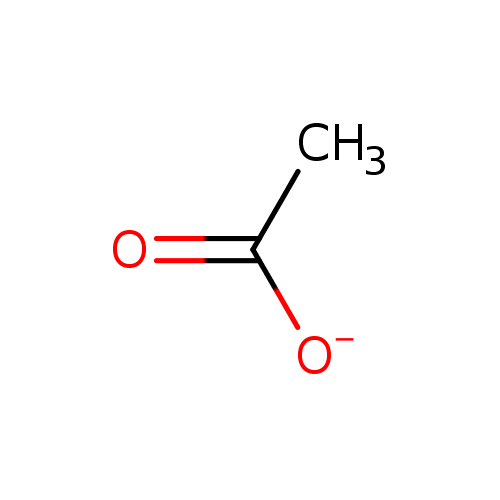
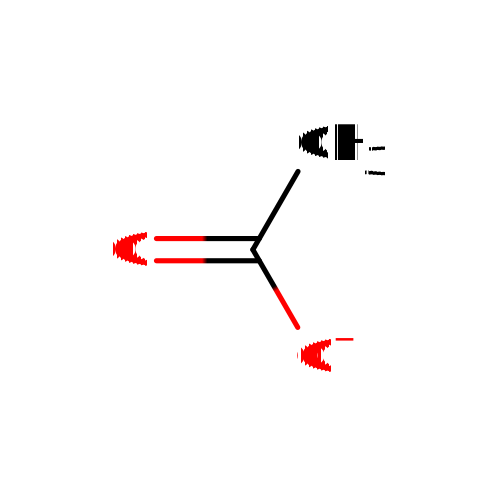
| Chemical Structure | |
|---|
| Synonyms | | Synonym | | Acetasol | | Acetate | | ACETATE ion | | Acetic acid, ion(1-) | | Azetat | | Borofair | | CH3-COO(-) | | Ethanoat | | Ethanoate | | Ethanoic acid | | Ethylate | | Ethylic acid | | Glacial acetate | | Glacial acetic acid | | Kyselina octova | | MeCO2 anion | | Methanecarboxylate | | Methanecarboxylic acid | | Vinegar | | Vinegar acid | | Volsol | | VoSoL |
|
|---|
| Chemical Formula | C2H3O2 |
|---|
| Average Molecular Mass | 59.045 g/mol |
|---|
| Monoisotopic Mass | 59.014 g/mol |
|---|
| CAS Registry Number | 64-19-7 |
|---|
| IUPAC Name | acetate |
|---|
| Traditional Name | acetate |
|---|
| SMILES | CC([O-])=O |
|---|
| InChI Identifier | InChI=1S/C2H4O2/c1-2(3)4/h1H3,(H,3,4)/p-1 |
|---|
| InChI Key | InChIKey=QTBSBXVTEAMEQO-UHFFFAOYSA-M |
|---|
| Chemical Taxonomy |
|---|
| Description | belongs to the class of organic compounds known as carboxylic acids. Carboxylic acids are compounds containing a carboxylic acid group with the formula -C(=O)OH. |
|---|
| Kingdom | Organic compounds |
|---|
| Super Class | Organic acids and derivatives |
|---|
| Class | Carboxylic acids and derivatives |
|---|
| Sub Class | Carboxylic acids |
|---|
| Direct Parent | Carboxylic acids |
|---|
| Alternative Parents | |
|---|
| Substituents | - Monocarboxylic acid or derivatives
- Carboxylic acid
- Organic oxygen compound
- Organic oxide
- Hydrocarbon derivative
- Organooxygen compound
- Carbonyl group
- Organic anion
- Aliphatic acyclic compound
|
|---|
| Molecular Framework | Aliphatic acyclic compounds |
|---|
| External Descriptors | |
|---|
| Biological Properties |
|---|
| Status | Detected and Not Quantified |
|---|
| Origin | Endogenous |
|---|
| Cellular Locations | - Cytoplasm
- Extracellular
- Golgi apparatus
- Mitochondria
|
|---|
| Biofluid Locations | Not Available |
|---|
| Tissue Locations | - Kidney
- Liver
- Most Tissues
|
|---|
| Pathways | |
|---|
| Applications | |
|---|
| Biological Roles | |
|---|
| Chemical Roles | |
|---|
| Physical Properties |
|---|
| State | Liquid |
|---|
| Appearance | Colorless liquid. |
|---|
| Experimental Properties | | Property | Value |
|---|
| Melting Point | 16.6°C | | Boiling Point | 117.9°C | | Solubility | 1E+006 mg/L (at 25°C) | | LogP | -0.17 |
|
|---|
| Predicted Properties | |
|---|
| Spectra |
|---|
| Spectra | | Spectrum Type | Description | Splash Key | Deposition Date | View |
|---|
| Predicted LC-MS/MS | Predicted LC-MS/MS Spectrum - 10V, Positive | splash10-03di-9000000000-f5685ebb25f1bef6afea | 2016-08-02 | View Spectrum | | Predicted LC-MS/MS | Predicted LC-MS/MS Spectrum - 20V, Positive | splash10-03di-9000000000-f6251d3582ace30e2bab | 2016-08-02 | View Spectrum | | Predicted LC-MS/MS | Predicted LC-MS/MS Spectrum - 40V, Positive | splash10-01ot-9000000000-7848c7adcde448d800ac | 2016-08-02 | View Spectrum | | Predicted LC-MS/MS | Predicted LC-MS/MS Spectrum - 10V, Negative | splash10-0a4i-9000000000-0828d9d6bd37d8a55106 | 2016-08-03 | View Spectrum | | Predicted LC-MS/MS | Predicted LC-MS/MS Spectrum - 20V, Negative | splash10-0a4i-9000000000-97ec887bce4752e1c84d | 2016-08-03 | View Spectrum | | Predicted LC-MS/MS | Predicted LC-MS/MS Spectrum - 40V, Negative | splash10-0a4i-9000000000-22e58030e49b08ff4d50 | 2016-08-03 | View Spectrum |
|
|---|
| Toxicity Profile |
|---|
| Route of Exposure | Oral (21) ; ihalation (21) ; ingestion (21) |
|---|
| Mechanism of Toxicity | Acetic acid is toxic due to its corrosive nature. In addition to causing skin burns and irritation to the mucous membranes, ingestion can result in severe damage to the digestive system and a potentially lethal change in the acidity of the blood. (20) |
|---|
| Metabolism | Acetic acid is is absorbed from the gastrointestinal tract and through the lungs. It is completely oxidized by the tissues, with metabolism involving the formation of ketone bodies. The products of acetic acid are used in the formation of glycogen, as intermediates of carbohydrates and fatty acid synthesis, and in cholesterol synthesis. In addition, acetic acid participates in the acetylation of amines and formation of proteins of plasma, liver, kidney, gut mucosa, muscle, and brain. (21) |
|---|
| Toxicity Values | LD50: 3.53 g/kg (Oral, Rat) (17)
LD50: 525 mg/kg (Intravenous, Mouse) (16)
LD50: 1060 mg/kg (Dermal, Rabbit) (16)
LC50: 5620 ppm over 1 hour (Inhalation, Mouse) (1) |
|---|
| Lethal Dose | Not Available |
|---|
| Carcinogenicity (IARC Classification) | No indication of carcinogenicity to humans (not listed by IARC). |
|---|
| Uses/Sources | Acetic acid gives vinegar its sour taste and pungent smell. It is an important chemical reagent and industrial chemical, used in the plastic, pharmaceutical, dye, insecticide, textile, rubber, and photographic industries. Water-free acetic acid (glacial acetic acid) is used in the production of certain fragrances. (20) Used to treat infections in the ear canal. |
|---|
| Minimum Risk Level | Not Available |
|---|
| Health Effects | Concentrated acetic acid is corrosive and can cause skin burns, permanent eye damage, and irritation to the mucous membranes. Ingestion can cause severe damage to the digestive system and a potentially lethal change in the acidity of the blood. (20) |
|---|
| Symptoms | Acetic acid is corrosive and can cause skin burns and irritation to the mucous membranes. These burns or blisters may not appear until hours after exposure. (20) |
|---|
| Treatment | In cases of skin or eye exposure, the area should be flushed with water and burns covered with dry, sterile dressings after decontamination. If ingested, rinse mouth and administer 5 mL/kg up to 200 mL of water for dilution. Watch for signs of respiratory insufficiency and assist respiration if necessary. (2) |
|---|
| Normal Concentrations |
|---|
| Not Available |
|---|
| Abnormal Concentrations |
|---|
| Not Available |
|---|
| External Links |
|---|
| DrugBank ID | DB03166 |
|---|
| HMDB ID | HMDB00042 |
|---|
| PubChem Compound ID | 176 |
|---|
| ChEMBL ID | CHEMBL539 |
|---|
| ChemSpider ID | 171 |
|---|
| KEGG ID | C00033 |
|---|
| UniProt ID | Not Available |
|---|
| OMIM ID | 276100 , 601705 |
|---|
| ChEBI ID | 30089 |
|---|
| BioCyc ID | ACET |
|---|
| CTD ID | Not Available |
|---|
| Stitch ID | Acetic acid |
|---|
| PDB ID | ACY |
|---|
| ACToR ID | 3254 |
|---|
| Wikipedia Link | Acetic_acid |
|---|
| References |
|---|
| Synthesis Reference | Earl M. Chamberlin, Warren K. Russ, Jr., George G. Hazen, “Process for preparing [1-oxo-2-cyclopentyl (or 2-isopropyl)-2-methyl-6,7-dichloro-5-indanyloxy] acetic acid.” U.S. Patent US3950408, issued April, 1928. |
|---|
| MSDS | Link |
|---|
| General References | - Skouby AP, Hippe E, Olesen H: Antibody to transcobalamin II and B12 binding capacity in patients treated with hydroxocobalamin. Blood. 1971 Dec;38(6):769-74. [5126165 ]
- Gidlof AC, Ocaya P, Olofsson PS, Torma H, Sirsjo A: Differences in retinol metabolism and proliferative response between neointimal and medial smooth muscle cells. J Vasc Res. 2006;43(4):392-8. Epub 2006 Jul 6. [16837774 ]
- Muniz-Junqueira MI, Braga Lopes C, Magalhaes CA, Schleicher CC, Veiga JP: Acute and chronic influence of hemodialysis according to the membrane used on phagocytic function of neutrophils and monocytes and pro-inflammatory cytokines production in chronic renal failure patients. Life Sci. 2005 Nov 4;77(25):3141-55. Epub 2005 Jul 11. [16005905 ]
- Silwood CJ, Lynch E, Claxson AW, Grootveld MC: 1H and (13)C NMR spectroscopic analysis of human saliva. J Dent Res. 2002 Jun;81(6):422-7. [12097436 ]
- Sugawara G, Nagino M, Nishio H, Ebata T, Takagi K, Asahara T, Nomoto K, Nimura Y: Perioperative synbiotic treatment to prevent postoperative infectious complications in biliary cancer surgery: a randomized controlled trial. Ann Surg. 2006 Nov;244(5):706-14. [17060763 ]
- Camoutsis C, Trafalis D, Pairas G, Papageorgiou A: On the formation of 4-[N,N-bis(2-chloroethyl)amino]phenyl acetic acid esters of hecogenin and aza-homo-hecogenin and their antileukemic activity. Farmaco. 2005 Oct;60(10):826-9. Epub 2005 Aug 31. [16139280 ]
- Subramanian A, Gupta A, Saxena S, Gupta A, Kumar R, Nigam A, Kumar R, Mandal SK, Roy R: Proton MR CSF analysis and a new software as predictors for the differentiation of meningitis in children. NMR Biomed. 2005 Jun;18(4):213-25. [15627241 ]
- Nicholson JK, Foxall PJ, Spraul M, Farrant RD, Lindon JC: 750 MHz 1H and 1H-13C NMR spectroscopy of human blood plasma. Anal Chem. 1995 Mar 1;67(5):793-811. [7762816 ]
- Li M, Pan XL, Wang LL, Feng Y, Huang N, Wu Q, Li X, Wang BY: [Study of antmicrobial mechanisms of human cervical mucus: isolation and characterization of antibacterial polypeptides]. Zhonghua Yi Xue Za Zhi. 2005 Apr 27;85(16):1109-12. [16029568 ]
- Vaca G, Hernandez A, Ibarra B, Velazquez A, Olivares N, Sanchez-Corona J, Medina C, Cantu JM: Detection of inborn errors of metabolism in 1,117 patients studied because of suspected inherited disease. Arch Invest Med (Mex). 1981;12(3):341-8. [7294941 ]
- Commodari F, Arnold DL, Sanctuary BC, Shoubridge EA: 1H NMR characterization of normal human cerebrospinal fluid and the detection of methylmalonic acid in a vitamin B12 deficient patient. NMR Biomed. 1991 Aug;4(4):192-200. [1931558 ]
- Yagi K, Nakamura A, Sekine A: [Magnification endoscopy diagnosis of Barrett's esophagus with methylene blue and acetic acid]. Nihon Rinsho. 2005 Aug;63(8):1411-5. [16101231 ]
- Fan DD, Luo Y, Mi Y, Ma XX, Shang L: Characteristics of fed-batch cultures of recombinant Escherichia coli containing human-like collagen cDNA at different specific growth rates. Biotechnol Lett. 2005 Jun;27(12):865-70. [16086249 ]
- Syrjanen K, Naud P, Derchain S, Roteli-Martins C, Longatto-Filho A, Tatti S, Branca M, Erzen M, Hammes LS, Matos J, Gontijo R, Sarian L, Braganca J, Arlindo FC, Maeda MY, Lorincz A, Dores GB, Costa S, Syrjanen S: Comparing PAP smear cytology, aided visual inspection, screening colposcopy, cervicography and HPV testing as optional screening tools in Latin America. Study design and baseline data of the LAMS study. Anticancer Res. 2005 Sep-Oct;25(5):3469-80. [16101165 ]
- Yri OE, Bjoro T, Fossa SD: Failure to achieve castration levels in patients using leuprolide acetate in locally advanced prostate cancer. Eur Urol. 2006 Jan;49(1):54-8; discussion 58. Epub 2005 Nov 15. [16314038 ]
- Lewis RJ (1996). Sax's Dangerous Properties of Industrial Materials. 9th ed. Volumes 1-3. New York, NY: Van Nostrand Reinhold.
- O'Neil MJ (ed) (2001). The Merck Index - An Encyclopedia of Chemicals, Drugs, and Biologicals. 13th ed. Whitehouse Station, NJ: Merck and Co., Inc.
- Bronstein, AC, Currance PL (1994). Emergency Care for Hazardous Materials Exposure. 2nd ed. St. Louis, MO. Mosby Lifeline. 1994.
- EPA/Office of Pollution Prevention and Toxics (2003). High Production Volume (HPV) Challenge Program's Robust Summaries and Test Plans.
- Wikipedia. Acetic Acid. Last Updated 14 November 2009. [Link]
- Food and Agriculture Organization of the United Nations/World Health Organization (1967).Tenth Report of the Joint FAO/WHO Expert Committee on Food Additives, FAO Nutrition Meetings Report Series. [Link]
- eMedicine [Link]
|
|---|
| Gene Regulation |
|---|
| Up-Regulated Genes | | Gene | Gene Symbol | Gene ID | Interaction | Chromosome | Details |
|---|
|
|---|
| Down-Regulated Genes | Not Available |
|---|