| Record Information |
|---|
| Version | 2.0 |
|---|
| Creation Date | 2009-03-06 18:58:14 UTC |
|---|
| Update Date | 2014-12-24 20:21:17 UTC |
|---|
| Accession Number | T3D0182 |
|---|
| Identification |
|---|
| Common Name | Phenol |
|---|
| Class | Small Molecule |
|---|
| Description | Phenol, is a toxic, colourless crystalline solid with a sweet tarry odor that resembles a hospital smell. It is commonly used as an antiseptic and disinfectant. It is active against a wide range of micro-organisms including some fungi and viruses, but is only slowly effective against spores. It has been used to disinfect skin and to relieve itching. Phenol is also used in the preparation of cosmetics including sunscreens, hair dyes, and skin lightening preparations. It is also used in the production of drugs (it is the starting material in the industrial production of aspirin), weedkillers, and synthetic resins. Phenol can be found in areas with high levels of motor traffic, therefore, people living in crowded urban areas are frequently exposed to traffic-derived phenol vapor. The average (mean +/- SD) phenol concentration in urine among normal individuals living in urban areas is 7.4 +/- 2.2 mg/g of creatinine. Exposure of the skin to concentrated phenol solutions causes chemical burns which may be severe; in laboratories where it is used, it is usually recommended that polyethylene glycol solution is kept available for washing off splashes. Notwithstanding the effects of concentrated solutions, it is also used in cosmetic surgery as an exfoliant, to remove layers of dead skin (Wikipedia). In some bacteria phenol can be directly synthesized from tyrosine via the enzyme tyrosine phenol-lyase [EC:4.1.99.2]. |
|---|
| Compound Type | - Anti-Infective Agent, Local
- Antipsoriatic Agent
- Antiseptic Agent
- Aromatic Hydrocarbon
- Disinfectant
- Drug
- Food Toxin
- Household Toxin
- Industrial/Workplace Toxin
- Metabolite
- Natural Compound
- Organic Compound
- Pollutant
- Sclerosing Solution
|
|---|
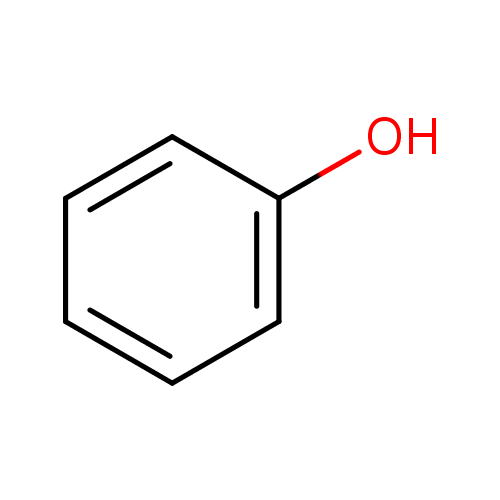
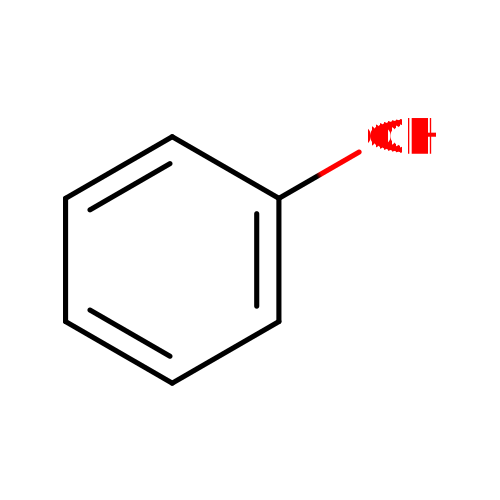
| Chemical Structure | |
|---|
| Synonyms | | Synonym | | Anbesol | | Benzenol | | Benzophenol | | Campho-phenique cold sore gel | | Campho-phenique gel | | Campho-phenique liquid | | Carbolic acid | | Carbolic acid liquid | | Carbolic oil | | Carbolsaeure | | Carbolsaure | | Cepastat lozenges | | Fenol | | Fenolo | | Fenosmolin | | Fenosmoline | | Hydroxy-benzene | | Hydroxybenzene | | IPH | | IZAL | | Karbolsaeure | | Liquid phenol | | Liquified phenol | | Monohydroxy benzene | | Monohydroxybenzene | | Monophenol | | Oxybenzene | | Paoscle | | Phenic | | Phenic acid | | Phenic alcohol | | Phenol alcohol | | Phenol liquid | | Phenolated water | | Phenole | | Phenosmolin | | Phenyl alcohol | | Phenyl hydroxide | | Phenylic acid | | Phenylic alcohol | | PHOH | | Synthetic phenol | | Tea polyphenol |
|
|---|
| Chemical Formula | C6H6O |
|---|
| Average Molecular Mass | 94.111 g/mol |
|---|
| Monoisotopic Mass | 94.042 g/mol |
|---|
| CAS Registry Number | 108-95-2 |
|---|
| IUPAC Name | phenol |
|---|
| Traditional Name | phenol |
|---|
| SMILES | OC1=CC=CC=C1 |
|---|
| InChI Identifier | InChI=1S/C6H6O/c7-6-4-2-1-3-5-6/h1-5,7H |
|---|
| InChI Key | InChIKey=ISWSIDIOOBJBQZ-UHFFFAOYSA-N |
|---|
| Chemical Taxonomy |
|---|
| Description | belongs to the class of organic compounds known as 1-hydroxy-4-unsubstituted benzenoids. These are phenols that are unsubstituted at the 4-position. |
|---|
| Kingdom | Organic compounds |
|---|
| Super Class | Benzenoids |
|---|
| Class | Phenols |
|---|
| Sub Class | 1-hydroxy-4-unsubstituted benzenoids |
|---|
| Direct Parent | 1-hydroxy-4-unsubstituted benzenoids |
|---|
| Alternative Parents | |
|---|
| Substituents | - 1-hydroxy-4-unsubstituted benzenoid
- 1-hydroxy-2-unsubstituted benzenoid
- Monocyclic benzene moiety
- Organic oxygen compound
- Hydrocarbon derivative
- Organooxygen compound
- Aromatic homomonocyclic compound
|
|---|
| Molecular Framework | Aromatic homomonocyclic compounds |
|---|
| External Descriptors | |
|---|
| Biological Properties |
|---|
| Status | Detected and Not Quantified |
|---|
| Origin | Exogenous |
|---|
| Cellular Locations | |
|---|
| Biofluid Locations | Not Available |
|---|
| Tissue Locations | - Adipose Tissue
- Bladder
- Brain
- Epidermis
- Fibroblasts
- Intestine
- Liver
- Muscle
- Nerve Cells
- Platelet
- Spleen
- Stratum Corneum
- Testes
- Thyroid Gland
|
|---|
| Pathways | Not Available |
|---|
| Applications | |
|---|
| Biological Roles | |
|---|
| Chemical Roles | Not Available |
|---|
| Physical Properties |
|---|
| State | Solid |
|---|
| Appearance | White powder. |
|---|
| Experimental Properties | | Property | Value |
|---|
| Melting Point | 40.9°C | | Boiling Point | 182°C (359.6°F) | | Solubility | 82.8 mg/mL at 25°C [SOUTHWORTH,GR & KELLER,JL (1986)] | | LogP | 1.46 |
|
|---|
| Predicted Properties | |
|---|
| Spectra |
|---|
| Spectra | | Spectrum Type | Description | Splash Key | Deposition Date | View |
|---|
| GC-MS | GC-MS Spectrum - GC-MS (1 TMS) | splash10-0udi-3900000000-97dfa3be718a9ee7ace4 | 2014-06-16 | View Spectrum | | GC-MS | GC-MS Spectrum - EI-B (Non-derivatized) | splash10-00kf-9000000000-6fb456992902a13931f9 | 2017-09-12 | View Spectrum | | GC-MS | GC-MS Spectrum - EI-B (Non-derivatized) | splash10-0006-9000000000-78c83ab6ff1d3dfdbec6 | 2017-09-12 | View Spectrum | | GC-MS | GC-MS Spectrum - EI-B (Non-derivatized) | splash10-0006-9000000000-89b0c430b8924ee2afde | 2017-09-12 | View Spectrum | | GC-MS | GC-MS Spectrum - EI-B (Non-derivatized) | splash10-0006-9000000000-fc01d0ad6740cfd70e13 | 2017-09-12 | View Spectrum | | GC-MS | GC-MS Spectrum - EI-B (Non-derivatized) | splash10-006w-9000000000-c8b41f2899ca8cc9d4bc | 2017-09-12 | View Spectrum | | GC-MS | GC-MS Spectrum - EI-B (Non-derivatized) | splash10-0006-9000000000-db80d8b605e20595c679 | 2017-09-12 | View Spectrum | | GC-MS | GC-MS Spectrum - GC-MS (Non-derivatized) | splash10-0udi-3900000000-97dfa3be718a9ee7ace4 | 2017-09-12 | View Spectrum | | Predicted GC-MS | Predicted GC-MS Spectrum - GC-MS (Non-derivatized) - 70eV, Positive | splash10-0006-9000000000-c35c89484e2499c62a49 | 2016-09-22 | View Spectrum | | Predicted GC-MS | Predicted GC-MS Spectrum - GC-MS (1 TMS) - 70eV, Positive | splash10-0g4i-9300000000-afd565a878ea36c74def | 2017-10-06 | View Spectrum | | Predicted GC-MS | Predicted GC-MS Spectrum - GC-MS (Non-derivatized) - 70eV, Positive | Not Available | 2021-10-12 | View Spectrum | | LC-MS/MS | LC-MS/MS Spectrum - Quattro_QQQ 10V, Negative (Annotated) | splash10-0006-9000000000-e67da0571423f0e6b4b8 | 2012-07-24 | View Spectrum | | LC-MS/MS | LC-MS/MS Spectrum - Quattro_QQQ 25V, Negative (Annotated) | splash10-0006-9000000000-e0f57b1e970d0d46597e | 2012-07-24 | View Spectrum | | LC-MS/MS | LC-MS/MS Spectrum - Quattro_QQQ 40V, Negative (Annotated) | splash10-0006-9000000000-e67da0571423f0e6b4b8 | 2012-07-24 | View Spectrum | | LC-MS/MS | LC-MS/MS Spectrum - EI-B (HITACHI RMU-7M) , Positive | splash10-00kf-9000000000-7bfe3b897e928a8f3a2c | 2012-08-31 | View Spectrum | | LC-MS/MS | LC-MS/MS Spectrum - EI-B (JEOL JMS-01-SG-2) , Positive | splash10-0006-9000000000-78c83ab6ff1d3dfdbec6 | 2012-08-31 | View Spectrum | | LC-MS/MS | LC-MS/MS Spectrum - EI-B (HITACHI RMU-6L) , Positive | splash10-0006-9000000000-89b0c430b8924ee2afde | 2012-08-31 | View Spectrum | | LC-MS/MS | LC-MS/MS Spectrum - EI-B (JEOL JMS-D-3000) , Positive | splash10-0006-9000000000-fc01d0ad6740cfd70e13 | 2012-08-31 | View Spectrum | | LC-MS/MS | LC-MS/MS Spectrum - EI-B (HITACHI M-80B) , Positive | splash10-0006-9000000000-ca4fa5905cccbfeab33a | 2012-08-31 | View Spectrum | | LC-MS/MS | LC-MS/MS Spectrum - 10V, Positive | splash10-0002-9000000000-e3e33defb000b450bb37 | 2021-09-20 | View Spectrum | | LC-MS/MS | LC-MS/MS Spectrum - 20V, Positive | splash10-0002-9200000000-d63db79771e5931b258f | 2021-09-20 | View Spectrum | | LC-MS/MS | LC-MS/MS Spectrum - 40V, Positive | splash10-0udi-9000000000-448a4d79ff53d77a8b16 | 2021-09-20 | View Spectrum | | Predicted LC-MS/MS | Predicted LC-MS/MS Spectrum - 10V, Positive | splash10-0002-9000000000-2c7201e803e029dd1aef | 2016-09-12 | View Spectrum | | Predicted LC-MS/MS | Predicted LC-MS/MS Spectrum - 20V, Positive | splash10-0002-9000000000-3fb3990dfbfbde2b8d57 | 2016-09-12 | View Spectrum | | Predicted LC-MS/MS | Predicted LC-MS/MS Spectrum - 40V, Positive | splash10-0gba-9000000000-d3da8db6579f32d02c6c | 2016-09-12 | View Spectrum | | Predicted LC-MS/MS | Predicted LC-MS/MS Spectrum - 10V, Negative | splash10-0006-9000000000-a74494cda18ab9fb8055 | 2016-09-12 | View Spectrum | | Predicted LC-MS/MS | Predicted LC-MS/MS Spectrum - 20V, Negative | splash10-0006-9000000000-a74494cda18ab9fb8055 | 2016-09-12 | View Spectrum | | Predicted LC-MS/MS | Predicted LC-MS/MS Spectrum - 40V, Negative | splash10-0006-9000000000-03a61ff7da92cb08edf8 | 2016-09-12 | View Spectrum | | Predicted LC-MS/MS | Predicted LC-MS/MS Spectrum - 10V, Positive | splash10-0002-9000000000-c65d4a4eaa8adde2ddb4 | 2021-09-24 | View Spectrum | | Predicted LC-MS/MS | Predicted LC-MS/MS Spectrum - 20V, Positive | splash10-014j-9000000000-def7a8d52afb63a3cd67 | 2021-09-24 | View Spectrum | | Predicted LC-MS/MS | Predicted LC-MS/MS Spectrum - 40V, Positive | splash10-0udi-9000000000-f3c795ffc788635ddbf4 | 2021-09-24 | View Spectrum | | Predicted LC-MS/MS | Predicted LC-MS/MS Spectrum - 10V, Negative | splash10-0006-9000000000-08485aaf085c13d5129a | 2021-09-24 | View Spectrum | | Predicted LC-MS/MS | Predicted LC-MS/MS Spectrum - 20V, Negative | splash10-0006-9000000000-08485aaf085c13d5129a | 2021-09-24 | View Spectrum | | Predicted LC-MS/MS | Predicted LC-MS/MS Spectrum - 40V, Negative | splash10-0006-9000000000-52b0f93832ef13f17bd2 | 2021-09-24 | View Spectrum | | MS | Mass Spectrum (Electron Ionization) | splash10-00kf-9000000000-40b376f4e58c23369a01 | 2014-09-20 | View Spectrum | | 1D NMR | 1H NMR Spectrum (1D, 600 MHz, H2O, experimental) | Not Available | 2012-12-04 | View Spectrum | | 1D NMR | 1H NMR Spectrum (1D, 400 MHz, CDCl3, experimental) | Not Available | 2014-09-20 | View Spectrum | | 1D NMR | 13C NMR Spectrum (1D, 25.16 MHz, CDCl3, experimental) | Not Available | 2014-09-23 | View Spectrum | | 2D NMR | [1H, 13C]-HSQC NMR Spectrum (2D, 600 MHz, H2O, experimental) | Not Available | 2012-12-05 | View Spectrum |
|
|---|
| Toxicity Profile |
|---|
| Route of Exposure | Inhalation (29) ; oral (29) ; dermal (29) ; eye contact (29) |
|---|
| Mechanism of Toxicity | Phenol is irritating and corrosive at high concentrations. Phenol impairs the stratum corneum and produces coagulation necrosis by denaturing and precipitating proteins. It is suggested that dermal application of phenol increases the formation of free radicals in the skin, and that the redox cycling of these radicals reduces antioxidant capacity, leading to significant oxidative damage of protein, DNA, and lipids. Phenol also act as a cyclooxygenase inhibitor. (5, 30) |
|---|
| Metabolism | When it is absorbed through the lungs, gut, or skin, phenol conjugated at the portal-of-entry and free phenol enter the bloodstream where it can then be distributed throughout the body. The dilution of phenol in water enhances the dermal absorption of phenol. Three different enzymes systems catalyze the reactions that transform phenol. Cytosolic phenol sulfotransferases catalyze the transfer of inorganic sulfur from the activated 3'-phosphoadenosine-5'phosphosulfate donor molecule to the hydroxyl group on phenol. Microsomal membrane-located uridine diphosphate (UDP) glucuronosyltransferases catalyze the transfer of an activated glucuronic acid molecule to the hydroxyl moiety of phenol to form an O-glucuronide conjugate. Cytochrome P4502E1, also microsomally located, catalyzes the hydroxylation of phenol to form hydroquinone (and to a much lesser extent, catechol), which is then acted upon by the phase II enzymes. Hydroquinone can, in turn, form conjugates, undergo peroxidation to form benzoquinone, or undergo further oxidation to form trihydroxybenzene. All three enzyme systems that metabolize phenol are found in multiple tissues and there is competition among them not only for phenol, but also for subsequent oxidative products, like hydroquinone. As a consequence, the relative amount of the products formed can vary based on species, dose and route of administration. Cytochromes other than CYP2E1, such as CYP2F2 are suggested to participate in the phenol metabolism in the liver. Tyrosinase also catalyzes the oxidation of phenols. The gastrointestinal tract, liver, lung, and kidney appear to be the major sites of phenol sulfate and glucuronide conjugation of simple phenols. Phenol, in its free and conjugated forms, is a normal constituent of human urine. (30, 2, 4, 1, 3) |
|---|
| Toxicity Values | LD50: 400 mg/kg/day (Oral, Rat) (30)
LD50: 669 mg/cm2/day (Dermal, Rat) (30)
LD50: 1400 mg/cm2/day (Dermal, Rabbit) (30) |
|---|
| Lethal Dose | Not Available |
|---|
| Carcinogenicity (IARC Classification) | 3, not classifiable as to its carcinogenicity to humans. (31) |
|---|
| Uses/Sources | Phenol is used to make plastics. Phenol is also used as a disinfectant in household cleaning products and in consumer products such as mouthwashes, gargles, throat sprays. Exposure may result from breathing air containing phenol and drinking contaminated water or eating food contaminated with phenol. Exposure also occurs through dermal contact with contaminated air or by skin contact with products containing phenol. Dermal contact can occur through the use of general disinfectants and ointments containing phenol. Ingestion can occur through the use of products such as throat lozenges or sore throat sprays that contain phenol. (30) |
|---|
| Minimum Risk Level | Acute Oral: 1 mg/kg/day (Rat) (30) |
|---|
| Health Effects | Long-term exposure to phenol at work has been associated with cardiovascular disease, irritation of the respiratory tract and muscle twitching depedning of the route of exposure. Ingestion of liquid products containing concentrated phenol can cause serious gastrointestinal damage and even death. Application of concentrated phenol to the skin can cause severe skin damage. Longer-term exposure to high levels of phenol caused damaged to the heart, kidneys, liver, and lungs. Liver effects, as judged by increased serum activities of alanine aminotransferase (ALT) and aspartate amino transferase (AST), were also reported in a case of prolonged inhalation exposure to phenol. (30) |
|---|
| Symptoms | Burning pain in mouth and throat; white necrotic lesions in mouth; abdominal pain, vomiting, bloody diarrhea, pallor, sweating, weakness, headache, dizziness, tinnitus can result from phenol poisoning. Phenol absorption can lead to weak irregular pulse, hypotension, shallow respirations, cyanosis, pallor, a profound fall in body temperature, muscle tremors, and difficulty walking. Possibly fleeting excitement and confusion, followed by unconsciousness. (27, 30) |
|---|
| Treatment | Not Available |
|---|
| Normal Concentrations |
|---|
| Not Available |
|---|
| Abnormal Concentrations |
|---|
| Not Available |
|---|
| External Links |
|---|
| DrugBank ID | DB03255 |
|---|
| HMDB ID | HMDB00228 |
|---|
| PubChem Compound ID | 996 |
|---|
| ChEMBL ID | Not Available |
|---|
| ChemSpider ID | 971 |
|---|
| KEGG ID | C00146 |
|---|
| UniProt ID | Not Available |
|---|
| OMIM ID | 147450 , 147460 , 171150 , 191740 , 600641 , 601292 |
|---|
| ChEBI ID | 15882 |
|---|
| BioCyc ID | 24-DICHLOROPHENOL |
|---|
| CTD ID | D019800 |
|---|
| Stitch ID | Phenol |
|---|
| PDB ID | IPH |
|---|
| ACToR ID | 1148 |
|---|
| Wikipedia Link | Phenol |
|---|
| References |
|---|
| Synthesis Reference | http://en.wikipedia.org/wiki/Phenols#Synthesis_of_phenols |
|---|
| MSDS | Link |
|---|
| General References | - Land EJ, Ramsden CA, Riley PA: The mechanism of suicide-inactivation of tyrosinase: a substrate structure investigation. Tohoku J Exp Med. 2007 Aug;212(4):341-8. [17660699 ]
- Tyapochkin E, Cook PF, Chen G: Isotope exchange at equilibrium indicates a steady state ordered kinetic mechanism for human sulfotransferase. Biochemistry. 2008 Nov 11;47(45):11894-9. doi: 10.1021/bi801211t. Epub 2008 Oct 18. [18928301 ]
- Li D, Fournel-Gigleux S, Barre L, Mulliert G, Netter P, Magdalou J, Ouzzine M: Identification of aspartic acid and histidine residues mediating the reaction mechanism and the substrate specificity of the human UDP-glucuronosyltransferases 1A. J Biol Chem. 2007 Dec 14;282(50):36514-24. Epub 2007 Oct 23. [17956868 ]
- Meinl W, Ebert B, Glatt H, Lampen A: Sulfotransferase forms expressed in human intestinal Caco-2 and TC7 cells at varying stages of differentiation and role in benzo[a]pyrene metabolism. Drug Metab Dispos. 2008 Feb;36(2):276-83. Epub 2007 Oct 29. [17967930 ]
- Oliveira HM, Sallam HS, Espana-Tenorio J, Chinkes D, Chung DH, Chen JD, Herndon DN: Gastric and small bowel ileus after severe burn in rats: the effect of cyclooxygenase-2 inhibitors. Burns. 2009 Dec;35(8):1180-4. doi: 10.1016/j.burns.2009.02.022. Epub 2009 May 22. [19464805 ]
- Chen X, Chen M, Xu B, Tang R, Han X, Qin Y, Xu B, Hang B, Mao Z, Huo W, Xia Y, Xu Z, Wang X: Parental phenols exposure and spontaneous abortion in Chinese population residing in the middle and lower reaches of the Yangtze River. Chemosphere. 2013 Sep;93(2):217-22. doi: 10.1016/j.chemosphere.2013.04.067. Epub 2013 May 25. [23714150 ]
- Gracies JM, Elovic E, McGuire J, Simpson DM: Traditional pharmacological treatments for spasticity. Part I: Local treatments. Muscle Nerve Suppl. 1997;6:S61-91. [9826983 ]
- Kilic SS, Aydin S, Kilic N, Erman F, Aydin S, Celik I: Serum arylesterase and paraoxonase activity in patients with chronic hepatitis. World J Gastroenterol. 2005 Dec 14;11(46):7351-4. [16437641 ]
- Tanaka T, Kasai K, Kita T, Tanaka N: Distribution of phenol in a fatal poisoning case determined by gas chromatography/mass spectrometry. J Forensic Sci. 1998 Sep;43(5):1086-8. [9729832 ]
- McDonald TA, Holland NT, Skibola C, Duramad P, Smith MT: Hypothesis: phenol and hydroquinone derived mainly from diet and gastrointestinal flora activity are causal factors in leukemia. Leukemia. 2001 Jan;15(1):10-20. [11243376 ]
- Guneral F, Bachmann C: Age-related reference values for urinary organic acids in a healthy Turkish pediatric population. Clin Chem. 1994 Jun;40(6):862-6. [8087979 ]
- Blades KJ, Patel S: The dynamics of tear flow within a phenol red impregnated thread. Ophthalmic Physiol Opt. 1996 Sep;16(5):409-15. [8944185 ]
- Miller WL, Doughty MJ, Narayanan S, Leach NE, Tran A, Gaume AL, Bergmanson JP: A comparison of tear volume (by tear meniscus height and phenol red thread test) and tear fluid osmolality measures in non-lens wearers and in contact lens wearers. Eye Contact Lens. 2004 Jul;30(3):132-7. [15499232 ]
- Hume R, Barker EV, Coughtrie MW: Differential expression and immunohistochemical localisation of the phenol and hydroxysteroid sulphotransferase enzyme families in the developing lung. Histochem Cell Biol. 1996 Feb;105(2):147-52. [8852436 ]
- Slatkin NE, Rhiner M: Phenol saddle blocks for intractable pain at end of life: report of four cases and literature review. Am J Hosp Palliat Care. 2003 Jan-Feb;20(1):62-6. [12568439 ]
- Bauer M, Patzelt D: A method for simultaneous RNA and DNA isolation from dried blood and semen stains. Forensic Sci Int. 2003 Sep 9;136(1-3):76-8. [12969623 ]
- Norberg J, Emneus JA, Jonsson JA, Mathiasson L, Burestedt E, Knutsson M, Marko-Varga G: On-line supported liquid membrane-liquid chromatography with a phenol oxidase-based biosensor as a selective detection unit for the determination of phenols in blood plasma. J Chromatogr B Biomed Sci Appl. 1997 Nov 7;701(1):39-46. [9389336 ]
- Tucker IG: A method to study the kinetics of oral mucosal drug absorption from solutions. J Pharm Pharmacol. 1988 Oct;40(10):679-83. [2907532 ]
- Achterrath-Tuckermann U, Saano V, Minker E, Stroman F, Arny I, Joki S, Nuutinen J, Szelenyi I: Influence of azelastine and some selected drugs on mucociliary clearance. Lung. 1992;170(4):201-9. [1522740 ]
- Tatsumi H, Shimada N, Kuramoto R, Mochizuki Y, Nishizima M, Arai M, Osanai K, Ishihara K, Goso K, Hotta K: [The phenol turbidity test for measurement of pulmonary surfactants in amniotic fluid--rapid test for fetal lung maturity (author's transl)]. Acta Obstet Gynaecol Jpn. 1981 May;33(5):643-50. [6894513 ]
- Jones AL, Hagen M, Coughtrie MW, Roberts RC, Glatt H: Human platelet phenolsulfotransferases: cDNA cloning, stable expression in V79 cells and identification of a novel allelic variant of the phenol-sulfating form. Biochem Biophys Res Commun. 1995 Mar 17;208(2):855-62. [7695643 ]
- Bartholomew LE, Bartholomew FN: Antigenic bacterial polysaccharide in rheumatoid synovial effusions. Arthritis Rheum. 1979 Sep;22(9):969-77. [314293 ]
- Le Poole IC, Yang F, Brown TL, Cornelius J, Babcock GF, Das PK, Boissy RE: Altered gene expression in melanocytes exposed to 4-tertiary butyl phenol (4-TBP): upregulation of the A2b adenosine receptor 1. J Invest Dermatol. 1999 Nov;113(5):725-31. [10571726 ]
- Bukowska B, Kowalska S: Phenol and catechol induce prehemolytic and hemolytic changes in human erythrocytes. Toxicol Lett. 2004 Aug 30;152(1):73-84. [15294349 ]
- Asai Y, Ohyama Y, Taiji Y, Makimura Y, Tamai R, Hashimoto M, Ogawa T: Treponema medium glycoconjugate inhibits activation of human gingival fibroblasts stimulated with phenol-water extracts of periodontopathic bacteria. J Dent Res. 2005 May;84(5):456-61. [15840783 ]
- Rumack BH (2009). POISINDEX(R) Information System. Englewood, CO: Micromedex, Inc. CCIS Volume 141, edition expires Aug, 2009.
- Gosselin RE, Smith RP, and Hodge HC (1984). Clinical Toxicology of Commercial Products. 5th ed. Baltimore: Williams and Wilkins.
- H. Babich, D.L. Davis, Phenol: A review of environmental and health risks. Regulatory Toxicology and Pharmacology, Volume 1, Issue 1, June 1981, Pages 90–109.
- ATSDR - Agency for Toxic Substances and Disease Registry (1999). Toxicological profile for chlorophenols. U.S. Public Health Service in collaboration with U.S. Environmental Protection Agency (EPA). [Link]
- ATSDR - Agency for Toxic Substances and Disease Registry (2008). Toxicological profile for phenol. U.S. Public Health Service in collaboration with U.S. Environmental Protection Agency (EPA). [Link]
- International Agency for Research on Cancer (2014). IARC Monographs on the Evaluation of Carcinogenic Risks to Humans. [Link]
|
|---|
| Gene Regulation |
|---|
| Up-Regulated Genes | | Gene | Gene Symbol | Gene ID | Interaction | Chromosome | Details |
|---|
|
|---|
| Down-Regulated Genes | | Gene | Gene Symbol | Gene ID | Interaction | Chromosome | Details |
|---|
|
|---|