| Record Information |
|---|
| Version | 2.0 |
|---|
| Creation Date | 2009-03-06 18:57:59 UTC |
|---|
| Update Date | 2014-12-24 20:20:59 UTC |
|---|
| Accession Number | T3D0052 |
|---|
| Identification |
|---|
| Common Name | Dibutyl phthalate |
|---|
| Class | Small Molecule |
|---|
| Description | Dibutyl phthalate is found in cloves. DBP was added to the California Proposition 65 (1986) list of suspected teratogens in November 2006. It is a suspected endocrine disruptor. It was used in some nail polishes; all major producers began eliminating this chemical from nail polishes in the Fall of 2006. Dibutyl phthalate (DBP) is a commonly used plasticizer. It is also used as an additive to adhesives or printing inks. It is soluble in various organic solvents, e.g. in alcohol, ether and benzene. DBP is also used as an ectoparasiticide. |
|---|
| Compound Type | - Aromatic Hydrocarbon
- Cosmetic Toxin
- Ester
- Ether
- Food Toxin
- Household Toxin
- Industrial/Workplace Toxin
- Metabolite
- Natural Compound
- Organic Compound
- Phthalate
- Plasticizer
- Pollutant
|
|---|
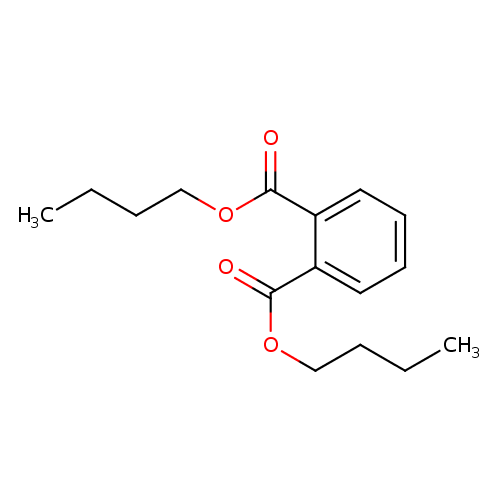
| Chemical Structure | |
|---|
| Synonyms | | Synonym | | 1,2-Benzenedicarboxylic acid, 1,2-dibutyl ester | | 1,2-Benzenedicarboxylic acid, dibutyl ester | | Araldite 502 | | Benzene-O-dicarboxylic acid di-N-butyl ester | | Benzene-O-dicarboxylic acid, di-N-butyl ester | | Benzenedicarboxylic acid, dibutyl ester | | BUFA | | Butyl phthalate | | Butylphthalate | | Celluflex DPB | | DBP (ester) | | Di N butyl phthalate | | Di-N-butyl phthalate | | Di-N-butyl phthalate (dbup) | | Di-N-butylester kyseliny ftalove | | Di-N-butylorthophthalate | | di-N-butyphthalatel | | Dibutyl 1, 2-benzenedicarboxylate | | Dibutyl 1,2-benzenedicarboxylate | | Dibutyl ester of 1,2-benzenedicarboxylic acid | | Dibutyl O-phthalate | | Dibutyl phthalated | | Dibutyl phthalic acid | | Dibutyl-1,2-benzenedicarboxylate | | Dibutyl-O-phthalate | | Dibutyl-Phthalate | | Dibutyll phthalate | | Dibutylphthalate | | Dibutylphthatlate | | Elaol | | Ergoplast FDB | | Ersoplast fda | | Genoplast B | | Hatcol DBP | | Hexaplas m/b | | Kodaflex DBP | | Morflex 240 | | N-Butyl phthalate | | N-Butylphthalate | | O-Benzenedicarboxylic acid, dibutyl ester | | Ortho-dibutyl phthalate | | Phthalic acid di-N-butyl ester | | Phthalic acid dibutyl ester | | Phthalic acid, dibutyl ester | | Polycizer DBP | | Rapidcelltrade markP | | RC plasticizer DBP | | Staflex DBP | | Uniflex DBP | | Unimoll DB | | Uniplex 150 | | Witcizer 300 |
|
|---|
| Chemical Formula | C16H22O4 |
|---|
| Average Molecular Mass | 278.344 g/mol |
|---|
| Monoisotopic Mass | 278.152 g/mol |
|---|
| CAS Registry Number | 84-74-2 |
|---|
| IUPAC Name | 1,2-dibutyl benzene-1,2-dicarboxylate |
|---|
| Traditional Name | dibutyl-phthalate |
|---|
| SMILES | CCCCOC(=O)C1=CC=CC=C1C(=O)OCCCC |
|---|
| InChI Identifier | InChI=1S/C16H22O4/c1-3-5-11-19-15(17)13-9-7-8-10-14(13)16(18)20-12-6-4-2/h7-10H,3-6,11-12H2,1-2H3 |
|---|
| InChI Key | InChIKey=DOIRQSBPFJWKBE-UHFFFAOYSA-N |
|---|
| Chemical Taxonomy |
|---|
| Description | belongs to the class of organic compounds known as benzoic acid esters. These are ester derivatives of benzoic acid. |
|---|
| Kingdom | Organic compounds |
|---|
| Super Class | Benzenoids |
|---|
| Class | Benzene and substituted derivatives |
|---|
| Sub Class | Benzoic acids and derivatives |
|---|
| Direct Parent | Benzoic acid esters |
|---|
| Alternative Parents | |
|---|
| Substituents | - Benzoate ester
- Benzoyl
- Dicarboxylic acid or derivatives
- Carboxylic acid ester
- Carboxylic acid derivative
- Organic oxygen compound
- Organic oxide
- Hydrocarbon derivative
- Organooxygen compound
- Aromatic homomonocyclic compound
|
|---|
| Molecular Framework | Aromatic homomonocyclic compounds |
|---|
| External Descriptors | |
|---|
| Biological Properties |
|---|
| Status | Detected and Not Quantified |
|---|
| Origin | Exogenous |
|---|
| Cellular Locations | |
|---|
| Biofluid Locations | Not Available |
|---|
| Tissue Locations | Not Available |
|---|
| Pathways | Not Available |
|---|
| Applications | |
|---|
| Biological Roles | |
|---|
| Chemical Roles | |
|---|
| Physical Properties |
|---|
| State | Solid |
|---|
| Appearance | Colorless oily liquid. |
|---|
| Experimental Properties | | Property | Value |
|---|
| Melting Point | 35°C | | Boiling Point | 340 °C | | Solubility | 0.0112 mg/mL at 25°C | | LogP | 4.5 |
|
|---|
| Predicted Properties | |
|---|
| Spectra |
|---|
| Spectra | | Spectrum Type | Description | Splash Key | Deposition Date | View |
|---|
| GC-MS | GC-MS Spectrum - CI-B (Non-derivatized) | splash10-0a6s-0490000000-bb10c8ff49d65e9fbcfd | 2017-09-12 | View Spectrum | | GC-MS | GC-MS Spectrum - EI-B (Non-derivatized) | splash10-0002-1910000000-964b3411de1f914de4da | 2017-09-12 | View Spectrum | | GC-MS | GC-MS Spectrum - EI-B (Non-derivatized) | splash10-0002-0910000000-97464fdc3b8040ec3d36 | 2017-09-12 | View Spectrum | | GC-MS | GC-MS Spectrum - CI-B (Non-derivatized) | splash10-052b-0960000000-7a12a722da333ebed5e0 | 2017-09-12 | View Spectrum | | GC-MS | GC-MS Spectrum - EI-B (Non-derivatized) | splash10-0002-5900000000-bb309d93583ab774d1f9 | 2017-09-12 | View Spectrum | | GC-MS | GC-MS Spectrum - CI-B (Non-derivatized) | splash10-0a6s-0490000000-bb10c8ff49d65e9fbcfd | 2018-05-18 | View Spectrum | | GC-MS | GC-MS Spectrum - EI-B (Non-derivatized) | splash10-0002-1910000000-964b3411de1f914de4da | 2018-05-18 | View Spectrum | | GC-MS | GC-MS Spectrum - EI-B (Non-derivatized) | splash10-0002-0910000000-97464fdc3b8040ec3d36 | 2018-05-18 | View Spectrum | | GC-MS | GC-MS Spectrum - CI-B (Non-derivatized) | splash10-052b-0960000000-7a12a722da333ebed5e0 | 2018-05-18 | View Spectrum | | GC-MS | GC-MS Spectrum - EI-B (Non-derivatized) | splash10-0002-5900000000-bb309d93583ab774d1f9 | 2018-05-18 | View Spectrum | | Predicted GC-MS | Predicted GC-MS Spectrum - GC-MS (Non-derivatized) - 70eV, Positive | splash10-0a4i-5190000000-8daed01d42925467217c | 2017-09-01 | View Spectrum | | Predicted GC-MS | Predicted GC-MS Spectrum - GC-MS (Non-derivatized) - 70eV, Positive | Not Available | 2021-10-12 | View Spectrum | | LC-MS/MS | LC-MS/MS Spectrum - LC-ESI-QFT , negative | splash10-004i-0590000000-d7fd13586fba8d9bcbb8 | 2017-09-14 | View Spectrum | | LC-MS/MS | LC-MS/MS Spectrum - LC-ESI-QFT , negative | splash10-003r-0900000000-26a0280d411587ad0406 | 2017-09-14 | View Spectrum | | LC-MS/MS | LC-MS/MS Spectrum - LC-ESI-QFT , negative | splash10-003r-0900000000-01dec35be5d4cb24d183 | 2017-09-14 | View Spectrum | | LC-MS/MS | LC-MS/MS Spectrum - LC-ESI-QFT , negative | splash10-00b9-1900000000-0a9f876d83f5cdff62be | 2017-09-14 | View Spectrum | | LC-MS/MS | LC-MS/MS Spectrum - LC-ESI-QFT , negative | splash10-004i-6900000000-88c2bba04cf08d8a94e7 | 2017-09-14 | View Spectrum | | LC-MS/MS | LC-MS/MS Spectrum - LC-ESI-QFT , negative | splash10-004i-9300000000-6e11d76c309a036870da | 2017-09-14 | View Spectrum | | LC-MS/MS | LC-MS/MS Spectrum - LC-ESI-QFT , negative | splash10-004i-9000000000-24ad78f1c73dbed6290d | 2017-09-14 | View Spectrum | | LC-MS/MS | LC-MS/MS Spectrum - LC-ESI-QFT , negative | splash10-004i-9000000000-2d5177b1586a4461b278 | 2017-09-14 | View Spectrum | | LC-MS/MS | LC-MS/MS Spectrum - LC-ESI-QFT , negative | splash10-004i-9000000000-4516fb7c10721dc8cedb | 2017-09-14 | View Spectrum | | LC-MS/MS | LC-MS/MS Spectrum - LC-ESI-QFT , positive | splash10-0002-0910000000-7702573da14ce44e4e73 | 2017-09-14 | View Spectrum | | LC-MS/MS | LC-MS/MS Spectrum - LC-ESI-QFT , positive | splash10-0002-0900000000-78eaf490a7fb4d87b419 | 2017-09-14 | View Spectrum | | LC-MS/MS | LC-MS/MS Spectrum - LC-ESI-QFT , positive | splash10-0002-0900000000-5c75cf8111466a2bd813 | 2017-09-14 | View Spectrum | | LC-MS/MS | LC-MS/MS Spectrum - LC-ESI-QFT , positive | splash10-0002-0900000000-a0747aefa385c43d47b1 | 2017-09-14 | View Spectrum | | LC-MS/MS | LC-MS/MS Spectrum - LC-ESI-QFT , positive | splash10-006t-1900000000-29635db4a2da5e62db7f | 2017-09-14 | View Spectrum | | LC-MS/MS | LC-MS/MS Spectrum - LC-ESI-QFT , positive | splash10-00xs-5900000000-02c97dee9727d0badc2e | 2017-09-14 | View Spectrum | | LC-MS/MS | LC-MS/MS Spectrum - LC-ESI-QFT , positive | splash10-014i-9200000000-2b0820b30884f0f997a5 | 2017-09-14 | View Spectrum | | LC-MS/MS | LC-MS/MS Spectrum - LC-ESI-QFT , positive | splash10-014i-9000000000-5d4f80a8a661596a7cc8 | 2017-09-14 | View Spectrum | | LC-MS/MS | LC-MS/MS Spectrum - LC-ESI-QFT , positive | splash10-014i-9000000000-f45a033b5a30528756de | 2017-09-14 | View Spectrum | | LC-MS/MS | LC-MS/MS Spectrum - LC-ESI-ITFT , positive | splash10-0002-0900000000-19ad0b11756e1ca9188a | 2017-09-14 | View Spectrum | | Predicted LC-MS/MS | Predicted LC-MS/MS Spectrum - 10V, Positive | splash10-056r-2090000000-80ca0d0b0000ed2e7f82 | 2016-06-03 | View Spectrum | | Predicted LC-MS/MS | Predicted LC-MS/MS Spectrum - 20V, Positive | splash10-0a4i-9240000000-62634d519d04aa7360b1 | 2016-06-03 | View Spectrum | | Predicted LC-MS/MS | Predicted LC-MS/MS Spectrum - 40V, Positive | splash10-0a4i-9500000000-7279733c1ed1974ee785 | 2016-06-03 | View Spectrum | | Predicted LC-MS/MS | Predicted LC-MS/MS Spectrum - 10V, Negative | splash10-004i-1090000000-5c82ef4822a947c8f20b | 2016-08-03 | View Spectrum | | Predicted LC-MS/MS | Predicted LC-MS/MS Spectrum - 20V, Negative | splash10-00fr-2590000000-eadc4a21565f062f1e5a | 2016-08-03 | View Spectrum | | Predicted LC-MS/MS | Predicted LC-MS/MS Spectrum - 40V, Negative | splash10-0600-5910000000-41f7de518636cfc255d9 | 2016-08-03 | View Spectrum | | MS | Mass Spectrum (Electron Ionization) | splash10-0002-3900000000-ecab0016129a96c4ece7 | 2014-09-20 | View Spectrum | | 1D NMR | 1H NMR Spectrum (1D, 90 MHz, CDCl3, experimental) | Not Available | 2014-09-20 | View Spectrum | | 1D NMR | 13C NMR Spectrum (1D, 25.16 MHz, CDCl3, experimental) | Not Available | 2014-09-23 | View Spectrum |
|
|---|
| Toxicity Profile |
|---|
| Route of Exposure | Oral (18) ; inhalation (18) ; dermal (18) |
|---|
| Mechanism of Toxicity | The most characteristic effect of di-n-butyl phthalate is testicular atrophy. Di-n-butyl phthalate exposure causes both the release of iron from hemoglobin and/or transferrin in the liver and spleen, and the subsequent depletion of iron in the blood and testes. The decreased amount of available iron results in a decrease in succinate dehydrogenase activity in the Sertoli cells. This results in disturbances in the energy transfer system between Sertoli cells and germ cells, which is required for the differentiation of male germ cells and their progression through the seminiferous epithelium and release as mature spermatozoa. Di-n-butyl phthalate may also exhibit weak estrogenic activity. It has been shown to exhibit toxic effects in liver mitochondria by uncoupling energy-linked processes and inhibiting succinate dehydrogenase. (18, 1) |
|---|
| Metabolism | Di-n-butyl phthalate is absorbed via oral, inhalation, and dermal routes. It is rapidly distributed and cleared from the body. Metabolism of di-n-butyl phthalate proceeds mainly by nonspecific esterases in the gastrointestinal tract, which hydrolyze of one butyl ester bond to yield mono-n-butyl phthalate, the primary toxic metabolite. Mono-n-butyl phthalate is conjugated with glucuronic acid via glucuronosyltransferase and excreted in the urine. (18) |
|---|
| Toxicity Values | LD50: 3050 mg/kg (Intraperitoneal, Rat) (16)
LD50: 720 mg/kg (Intravenous, Mouse) (16)
LD50: 5289 mg/kg (Oral, Mouse) (16)
LC50: 25 g/m3 over 2 hours (Inhalation, Mouse) (16) |
|---|
| Lethal Dose | Not Available |
|---|
| Carcinogenicity (IARC Classification) | No indication of carcinogenicity to humans (not listed by IARC). |
|---|
| Uses/Sources | Di-n-butyl phthalate is used to make plastics more flexible and is also in carpet backings, paints, glue, insect repellents, hair spray, nail polish, and rocket fuel. (18) |
|---|
| Minimum Risk Level | Not Available |
|---|
| Health Effects | Adverse effects from di-n-butyl phthalate exposure have not yet been reported in humans. However, animals studies have shown that di-n-butyl phthalate can affect reproductive ability by decreasing sperm count and causing birth defects. (18) |
|---|
| Symptoms | Skin contact with di-n-butyl phthalate may cause mild irritation. (18) |
|---|
| Treatment | Not Available |
|---|
| Normal Concentrations |
|---|
| Not Available |
|---|
| Abnormal Concentrations |
|---|
| Not Available |
|---|
| External Links |
|---|
| DrugBank ID | Not Available |
|---|
| HMDB ID | HMDB33244 |
|---|
| PubChem Compound ID | 3026 |
|---|
| ChEMBL ID | Not Available |
|---|
| ChemSpider ID | 13837319 |
|---|
| KEGG ID | C14214 |
|---|
| UniProt ID | Not Available |
|---|
| OMIM ID | |
|---|
| ChEBI ID | 535597 |
|---|
| BioCyc ID | Not Available |
|---|
| CTD ID | D003993 |
|---|
| Stitch ID | Di-n-butyl phthalate |
|---|
| PDB ID | Not Available |
|---|
| ACToR ID | 1740 |
|---|
| Wikipedia Link | Dibutyl_phthalate |
|---|
| References |
|---|
| Synthesis Reference | Not Available |
|---|
| MSDS | Link |
|---|
| General References | - Melnick RL, Schiller CM: Mitochondrial toxicity of phthalate esters. Environ Health Perspect. 1982 Nov;45:51-6. [7140696 ]
- Kim H, Lee S, Ryu S, Choi HT: Decolorization of Remazol Brilliant Blue R by a purified laccase of Polyporus brumalis. Appl Biochem Biotechnol. 2012 Jan;166(1):159-64. doi: 10.1007/s12010-011-9412-y. Epub 2011 Nov 5. [22057907 ]
- Gupta VK, Singh LP, Chandra S, Kumar S, Singh R, Sethi B: Anion recognition through amide-based dendritic molecule: a poly(vinyl chloride) based sensor for nitrate ion. Talanta. 2011 Aug 15;85(2):970-4. doi: 10.1016/j.talanta.2011.05.014. Epub 2011 May 12. [21726726 ]
- Cirillo T, Fasano E, Castaldi E, Montuori P, Amodio Cocchieri R: Children's exposure to Di(2-ethylhexyl)phthalate and dibutylphthalate plasticizers from school meals. J Agric Food Chem. 2011 Oct 12;59(19):10532-8. doi: 10.1021/jf2020446. Epub 2011 Sep 19. [21894916 ]
- Ito Y, Nakamura T, Yanagiba Y, Ramdhan DH, Yamagishi N, Naito H, Kamijima M, Gonzalez FJ, Nakajima T: Plasticizers May Activate Human Hepatic Peroxisome Proliferator-Activated Receptor alpha Less Than That of a Mouse but May Activate Constitutive Androstane Receptor in Liver. PPAR Res. 2012;2012:201284. doi: 10.1155/2012/201284. Epub 2012 Jun 20. [22792086 ]
- Simonsson C, Stenfeldt AL, Karlberg AT, Ericson MB, Jonsson CA: The pilosebaceous unit--a phthalate-induced pathway to skin sensitization. Toxicol Appl Pharmacol. 2012 Oct 1;264(1):114-20. doi: 10.1016/j.taap.2012.07.023. Epub 2012 Jul 27. [22842015 ]
- Petersen JH, Jensen LK: Phthalates and food-contact materials: enforcing the 2008 European Union plastics legislation. Food Addit Contam Part A Chem Anal Control Expo Risk Assess. 2010 Nov;27(11):1608-16. doi: 10.1080/19440049.2010.501825. [20737341 ]
- Fishman AI, Noskov AI, Stolov AA: Conformational mobility of small molecules in glass-forming solutions studied by FTIR spectroscopy. Spectrochim Acta A Mol Biomol Spectrosc. 2012 Jun;91:184-91. doi: 10.1016/j.saa.2012.01.060. Epub 2012 Feb 9. [22381789 ]
- Tyagi S, Agarwal H, Ikram S: A polyvinylchloride-based cadmium ion-selective electrode using [Mo(2)(OAc)(2)(H(2)-calix[4]arene)] as an electroactive material. Water Sci Technol. 2010;62(11):2510-8. doi: 10.2166/wst.2010.774. [21099036 ]
- Brucker-Davis F, Wagner-Mahler K, Bornebusch L, Delattre I, Ferrari P, Gal J, Boda-Buccino M, Pacini P, Tommasi C, Azuar P, Bongain A, Fenichel P: Exposure to selected endocrine disruptors and neonatal outcome of 86 healthy boys from Nice area (France). Chemosphere. 2010 Sep;81(2):169-76. doi: 10.1016/j.chemosphere.2010.06.068. [20663538 ]
- Dobrzynska MM, Tyrkiel EJ, Hernik A, Derezinska E, Goralczyk K, Ludwicki JK: [The effects of di-n-butyl phthalate on the somatic cells of laboratory mice]. Rocz Panstw Zakl Hig. 2010;61(1):13-9. [20803895 ]
- Carran M, Shaw IC: New Zealand Malayan war veterans' exposure to dibutylphthalate is associated with an increased incidence of cryptorchidism, hypospadias and breast cancer in their children. N Z Med J. 2012 Jul 29;125(1358):52-63. [22864157 ]
- Singh AK, Singh P: Determination of cerium ion by polymeric membrane and coated graphite electrode based on novel pendant armed macrocycle. Anal Chim Acta. 2010 Aug 24;675(2):170-80. doi: 10.1016/j.aca.2010.07.023. Epub 2010 Jul 21. [20800729 ]
- van Ravenzwaay B, Coelho-Palermo Cunha G, Strauss V, Wiemer J, Leibold E, Kamp H, Walk T, Mellert W, Looser R, Prokoudine A, Fabian E, Krennrich G, Herold M: The individual and combined metabolite profiles (metabolomics) of dibutylphthalate and di(2-ethylhexyl)phthalate following a 28-day dietary exposure in rats. Toxicol Lett. 2010 Oct 5;198(2):159-70. doi: 10.1016/j.toxlet.2010.06.009. Epub 2010 Jun 23. [20600714 ]
- Tyagi S, Agarwal H, Ikram S: Potentiometric polymeric membrane electrodes for mercury detection using calixarene ionophores. Water Sci Technol. 2010;61(3):693-704. doi: 10.2166/wst.2010.860. [20150706 ]
- Lewis RJ Sr. (ed) (2004). Sax's Dangerous Properties of Industrial Materials. 11th Edition. Hoboken, NJ: Wiley-Interscience, Wiley & Sons, Inc.
- Yannai, Shmuel. (2004) Dictionary of food compounds with CD-ROM: Additives, flavors, and ingredients. Boca Raton: Chapman & Hall/CRC.
- ATSDR - Agency for Toxic Substances and Disease Registry (2001). Toxicological profile for di-n-butyl phthalate. U.S. Public Health Service in collaboration with U.S. Environmental Protection Agency (EPA). [Link]
|
|---|
| Gene Regulation |
|---|
| Up-Regulated Genes | Not Available |
|---|
| Down-Regulated Genes | Not Available |
|---|